Main stories
UK economy- Back in recession
Budget 2012 - Analysis
Competition policy - New regulator planned
Fiscal union - Rejected by UK
Europe - A Tobin tax?
Euro Bailout - Agreement reached
Misery Index - Index hits 17 year high
UK economy - Quantitative easing
UK Chancellor - U-turn?
Credit ratings - US credit rating
Greek bailout - Euro problems
UK economy - Recession fears
Food prices - Food Price Index
Top universities for Economics
 
Keep up to date - contribute to discussion -watch videos...More..
Credit card Updates Get the latest updates on the UK economy, including GDP, inflation...More...
Global warming Climate change Delegates from 192 countries ... More...
  Study guides Latest resources for students from Economics Online.  More...
Multiple choice Test your knowledge of Economics. More...
Keyboard Economics Online resources.
City of London The financial crisis reveals a fundamental weakness .. More...


Equilibrium

An economy will be in equilibrium, that is it will be in a stable state, when planned withdrawals equal planned injections; hence savings, taxation and import spending (S + T + M) will equal investment, government spending and export revenue (I + G + X). This is also consistent with planned aggregate demand equalling planned aggregate supply.

Example

Equilibrium
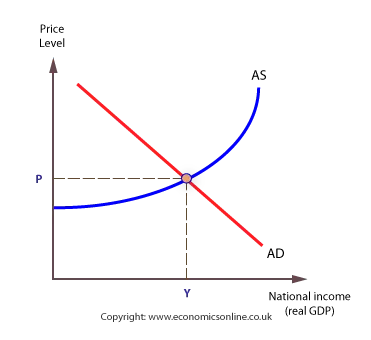
Equilibrium occurs at the price level where AD equals AS. In this hypothetical case, equilibrium output (Y) is at £600b, with a price level (in an index form) of 100.
PRICE LEVEL AD AS
200 50 700
180 160 700
160 270 700
140 380 680
120 490 660
100 600 600
80 719 100

Equilibrium can be shown using the AD-AS diagram, and will occur at the price level where AS and AD  equate. 

In our hypothetical example, equilibrium will be where the average price level is £100 and the value of output is £600b.

Video

Proving equilibrium

It is essential to explain why is equilibrium is achieved when AS = AD. In the example, at a price level higher than 100, such as 140, SRAS is greater than AD. Firms are producing more goods than the economy wants and needs.

Disequilibrium
At at price level of 140, supply is much greater than demand.
PRICE LEVEL AD AS
200 50 700
180 160 700
160 270 700
140 380 680
120 490 660
100 600 600
80 719 100

AD is effectively too low because at this high price level there are negative trade, liquidity and wealth effects, causing planned AD to contract to £380b.

Stocks rapidly build up, with planned output increasing to £680b. In an attempt to reduce these stock levels firms across the economy cut prices - until the price level falls back to 100!

At a price lower than 100, such as 80,  there is much less incentive to produce, and AS contracts to £100b.  However, AD extends to £710b because lower prices stimulate positive trade, liquidity, and wealth effects.

Disequilibrium
At at price level of 80, demand is much greater than supply.
PRICE LEVEL AD AS
200 50 700
180 160 700
160 270 700
140 380 680
120 490 660
100 600 600
80 719 100

Stocks quickly run down, and firms will raise their prices. The price level will eventually rise back up to reach a stable state at 100.

The response of AS to changes in AD

A movement along the AS curve will occur if the AD curve shifts to the left or right. For example, if the AD curve shifts to the right, AS will expand up along the curve, in response.

Movement along the AS curve

As aggregate demand increases, firms will run down stocks which triggers an increase in production. Graphically, there is an expansion along the aggregate supply curve.

Showing an output gap

An output gap occurs when there is a difference between the potential level of output and the actual short run level of output, as indicated on the graph below.

Output gaps may be negative, which occurs when actual output is less than potential output, or positive, when actual output is greater than potential output. An output gap can be illustrated using AD-AS analysis.

If an economy has a negative output gap, then it means it is capable of producing more output, without having to create or employ new factors of production. Current output is at Y, and full capacity is at Yf.

Such an output gap means there is likely to be unemployment, and possibly a recession.

Video

Injections and withdrawals

When total injections equal total withdrawals, the level of national income will remain constant, and the economy will be in general equilibrium.

The level of economic activity will change following a change in either injections or withdrawals. An economy will grow if the value of injections is greater than the value of withdrawals, or shrink if the value of withdrawals is greater than injections.

Economists often say that the economy is like a bathtub filling up - the level of the water in the bath will rise when the volume of water coming in increases relative to water going out.

General equilibrium

For an economy to be in general equilibrium it is only necessary that:

Total injections = total withdrawals

Injections and withdrawals

See: Different perspectives on equilibrium


Rss Feed Tweeter button Facebook button Linkedin button Digg button Youtube button