
Main stories
UK growth - UK avoids triple-dip recession
Benefit cap  - kicks in at £500 per week
UK Budget 2013 - analysis and comment
EU Budget - historic reduction agreed
UK economy - GDP falls by 0.3%
Quantitative Easing - put on hold
Poverty - recession and relative poverty
Welfare reform - the end of universal benefits
Underemployment - over 3 million
CPI inflation - at 2.7%
Autumn statement - austerity to continue
Energy prices - set to rise
Libor - rate fixing scandal
Greek exit - a little nearer
Competition policy - new regulator planned
Fiscal union - rejected by UK
Europe - a Tobin tax?
Credit ratings - US credit rating
Greek bailout - Euro problems
Top international universities for Economics
Top UK universities for Economics
 
Keep up to date - contribute to discussion -watch videos...More..
Updates Get the latest updates on the UK economy, including GDP, inflation...More...
Ask the tutor - your opportunity to ask a question...
  Study guides Latest resources for students from Economics Online.  More...
How to answer data response questions. More...
Multiple choice tests Improve knowledge and understanding of Economics. More...
Market structures revision presentations
Economics tuition - from specialist tutors. Find out more..or REGISTER
City of London The financial crisis reveals a fundamental weakness .. More...
Recommended texts


Tutors required Economics, Mathematics Business Studies Register here


Shifts in supply

The position of a supply curve will change following a change in one or more of the underlying determinants of supply. For example, a change in costs, such as a change in labour or raw material costs, will shift the position of the supply curve.

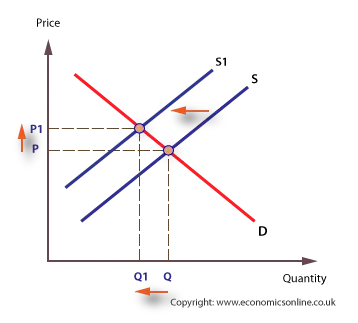
Rising costs

If costs rise, less can be produced at any given price, and the supply curve will shift to the left.
Falling costs

If costs fall, more can be produced, and the supply curve will shift to the right.
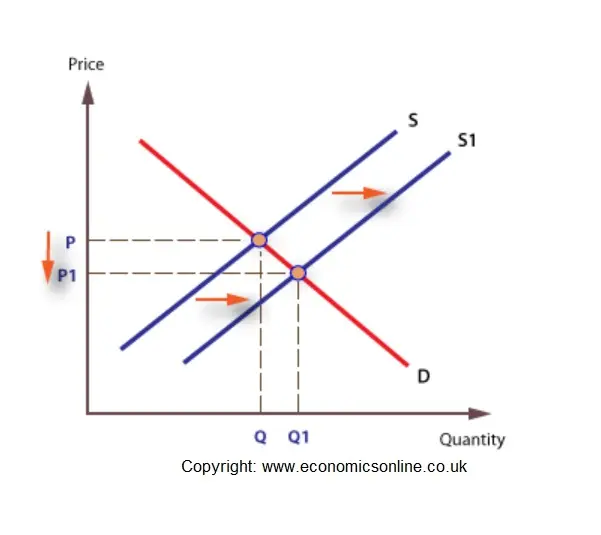
Any change in an underlying determinant of supply, such as a change in the availability of factors, or changes in weather, taxes, and subsidies, will shift the supply curve to the left or right.


Rss Feed Tweeter button Facebook button Linkedin button Digg button Youtube button