Main stories
UK growth - UK avoids triple-dip recession
Benefit cap  - kicks in at £500 per week
UK Budget 2013 - analysis and comment
EU Budget - historic reduction agreed
UK economy - GDP falls by 0.3%
Quantitative Easing - put on hold
Poverty - recession and relative poverty
Welfare reform - the end of universal benefits
Underemployment - over 3 million
CPI inflation - at 2.7%
Autumn statement - austerity to continue
Energy prices - set to rise
Libor - rate fixing scandal
Greek exit - a little nearer
Competition policy - new regulator planned
Fiscal union - rejected by UK
Europe - a Tobin tax?
Credit ratings - US credit rating
Greek bailout - Euro problems
Top international universities for Economics
Top UK universities for Economics
 
Keep up to date - contribute to discussion -watch videos...More..
Updates Get the latest updates on the UK economy, including GDP, inflation...More...
Ask the tutor - your opportunity to ask a question...
  Study guides Latest resources for students from Economics Online.  More...
How to answer data response questions. More...
Multiple choice tests Improve knowledge and understanding of Economics. More...
Keyboard Economics Online resources.
Economics tuition - from specialist tutors. Find out more..or REGISTER
City of London The financial crisis reveals a fundamental weakness .. More...
Recommended texts


OECD - Sustainable Development

United Nations Division for Sustainable Development


Tutors required Economics, Mathematics Business Studies Register here


Measures of economic welfare

During the late 1960s, many economists began to question the over-reliance of governments and agencies on narrow, exclusively GDP-based, measures of economic welfare. It was at this time that the adverse environmental effects of uncontrolled economic growth began to be considered, prompting the search for a wider measure of welfare, not exclusively based on raw GDP figures.

Nordhaus and Tobin

In 1972, Yale economists William Nordhaus and James Tobin introduced their Measure of Economic Welfare (MEW)* as an alternative to crude GDP. MEW took national output as a starting point, but adjusted it to include an assessment of the value of leisure time and the amount of unpaid work in an economy, hence increasing the welfare value of GDP. They also included the value of the environment damage caused by industrial production and consumption, which reduced the welfare value of GDP. MEW can be seen as the forerunner of later attempts to create a sophisticated index of sustainable development.
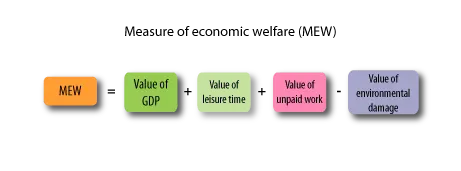
MEW

*Nordhaus, WD and Tobin, J (1972) Is Growth Obsolete? Economic Growth, National Bureau of Economic Research, no 96, New York.

The Index of Sustainable Economic Welfare

The Index of Sustainable Economic Welfare (ISEW), develops MEW by adjusting GDP further by taking into account a wider range of harmful effects of economic growth, and by excluding the value of public expenditure on defence.
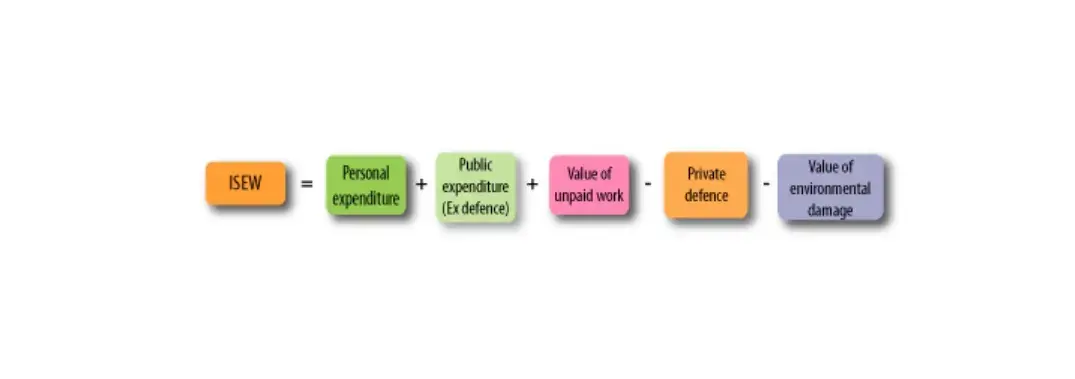

ISEW


Rss Feed Tweeter button Facebook button Linkedin button Digg button Youtube button