
Investment
Investment spending
Investment spending is an injection into the circular flow of income.
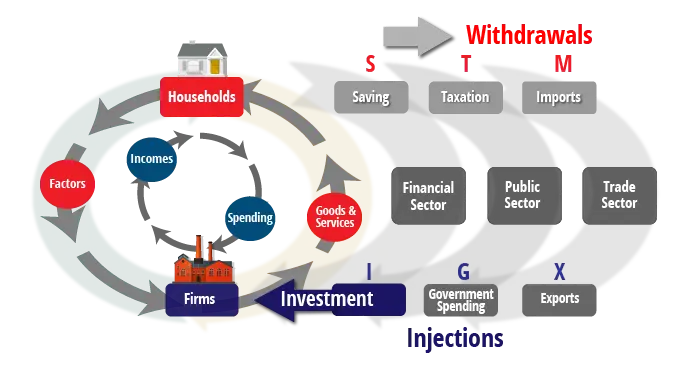
Investment refers to an increase in capital assets, and typically includes investment by business, investment in property (‘dwellings’) and investment by governments in ‘social’ capital. Business investment comprises between 65% and 85% of total investment in the majority of G7 countries.
Firms invest for two primary reasons:
- Firstly, investment may be required to replace worn out, or failing machinery, equipment, or buildings. This is referred to as capital consumption, and arises from the continuous depreciation of fixed capital assets.
- Secondly, investment may be undertaken to purchase new machinery, equipment, or buildings in order to increase productive capacity. This will reduce long-term costs, increase competitiveness, and raise profits.
Gross investment includes both types of investment spending, but net investment only measures new assets rather than the replacement of assets. This relationship is expressed in the following equation:
Net investment = gross investment – depreciation
For example, if an airline replaces five worn out aircraft with identical new aircraft, and purchases two more aircraft in order to be able to fly to more destinations, then gross investment is seven, replacement investment is five, and net investment is two.
In economic theory, net investment carries more significance, as it provides the basis for economic growth.
The determinants of investment
The level of investment in an economy tends to vary by a greater extent than other components of aggregate demand. This is because the underlying determinants also have a tendency to change.
The main determinants of investment are:
The expected return on the investment
Investment is a sacrifice, which involves taking risks. This means that businesses, entrepreneurs, and capital owners will require a return on their investment in order to cover this risk, and earn a reward. In terms of the whole economy, the amount of business profits is a good indication of the potential reward for investment.
Business confidence
Similarly, changes in business confidence can have a considerable influence on investment decisions. Uncertainty about the future can reduce confidence, and means that firms may postpone their investment decisions until confidence returns.
Changes in national income
Changes in national income create an accelerator effect. Economic theory suggests that, at the macro-economic level, small changes in national income can trigger much larger changes in investment levels.
Interest rates
Investment is inversely related to interest rates, which are the cost of borrowing and the reward to lending. Investment is inversely related to interest rates for two main reasons.
- Firstly, if interest rates rise, the opportunity cost of investment rises. This means that a rise in interest rates increases the return on funds deposited in an interest-bearing account, or from making a loan, which reduces the attractiveness of investment relative to lending. Hence, investment decisions may be postponed until interest rates return to lower levels.
- Secondly, if interest rates rise, firms may anticipate that consumers will reduce their spending, and the benefit of investing will be lost. Investing to expand requires that consumers at least maintain their current spending. Therefore, a predicted fall is likely to discourage firms from investing and force them to postpone their investment decisions.
General expectations
Because investment is a high-risk activity, general expectations about the future will influence a firm’s investment appraisal and eventual decision-making. Any indication of a downturn in the economy, a possible change of government, war or a rise in oil or other commodity prices may reduce the expected benefit or increase the expected cost of investment.
Corporation tax
Firms pay corporation tax on their profits, so a reduction in tax increases the profits they retain after tax is paid, and this acts as an incentive to invest. There current rate of 20% will fall to 19% in 2017, and then to 18% in 2020.
The level of savings
Household and corporate savings provides a flow of funds into the financial sector, which means that funds are available for investment. Increased saving may reduce interest rates and stimulate corporate borrowing and investment.
The accelerator effect
Small changes in household income and spending can trigger much larger changes in investment. This is because firms often expect new sales and orders to be sustained into the long run, and purchase larger quantities of capital goods than they need in the short run.
In addition, machinery is generally indivisible which means it cannot be broken into small amounts and bought separately. Even small increases in demand can trigger the need to buy complete new machines or build entirely new factories and premises, even though the increase in demand may be relatively small.
The combined effect of these two principles creates what is called the accelerator effect. For example, if in a given year national income rises by £20b, and investment rises by £40b, the value of the accelerator is 2.
- Read more on the accelerator effect
Showing the effects of an increase in capital investment
The initial impact of investment is on the AD curve, which shifts to the right as investment (I) is a component of AD, show shown below:

In the long run, the investment will increase the economy’s capacity to produce, which shifts the LRAS curve to the right. Finally, it is likely that production costs will fall as new technology increases efficiency and reduces average costs. This means that the SRAS curve shifts to the right. The combined effects are that the economy grows, both in terms of potential output and actual output, without inflationary pressure.
Recent changes in UK investment
After over a decade of continuous growth, gross investment fell during 2008 and 2009. Investment grew again during 2010, but fell back between 2011 and 2012, indicating the continuing negative impact of the recession on the availability of capital, and on business confidence.
By 2013 business investment had returned to its pre-recession levels. Despite the initial uncertainty surrounding the Brexit vote on June 23rd, 2016, investment in the UK continued to grow throughout 2016 and 2017. However, in the first and second quarter of 2018 gross investment fell, reflecting increasing uncertainty over the nature of the Brexit deal.