Intel’s 14A Bet: Technology Breakthrough or Costly Gamble
Intel was relegated last year from being one of the top three semiconductor revenue-generating companies; however, the company is still fighting for relevance in technology as its primary market competition. The main concern for investors is not about Intel's current profitability, but rather whether or not the company can successfully transition into contract manufacturing, and whether it can compete on equal footing with TSMC and Samsung within the advanced manufacturing process technologies.
Intel's 18A process technology is currently achieving yields above 60%, giving it a more competitive manufacturing process than Samsung and one that is only slightly behind the very early phases of TSMC’s 2nm production. While these results are strong on their own, they more importantly suggest that 18A is intended as a transitional phase for Intel. Its primary application will be in internally produced chips, serving as an evolving platform for the company’s next-generation 14A process.
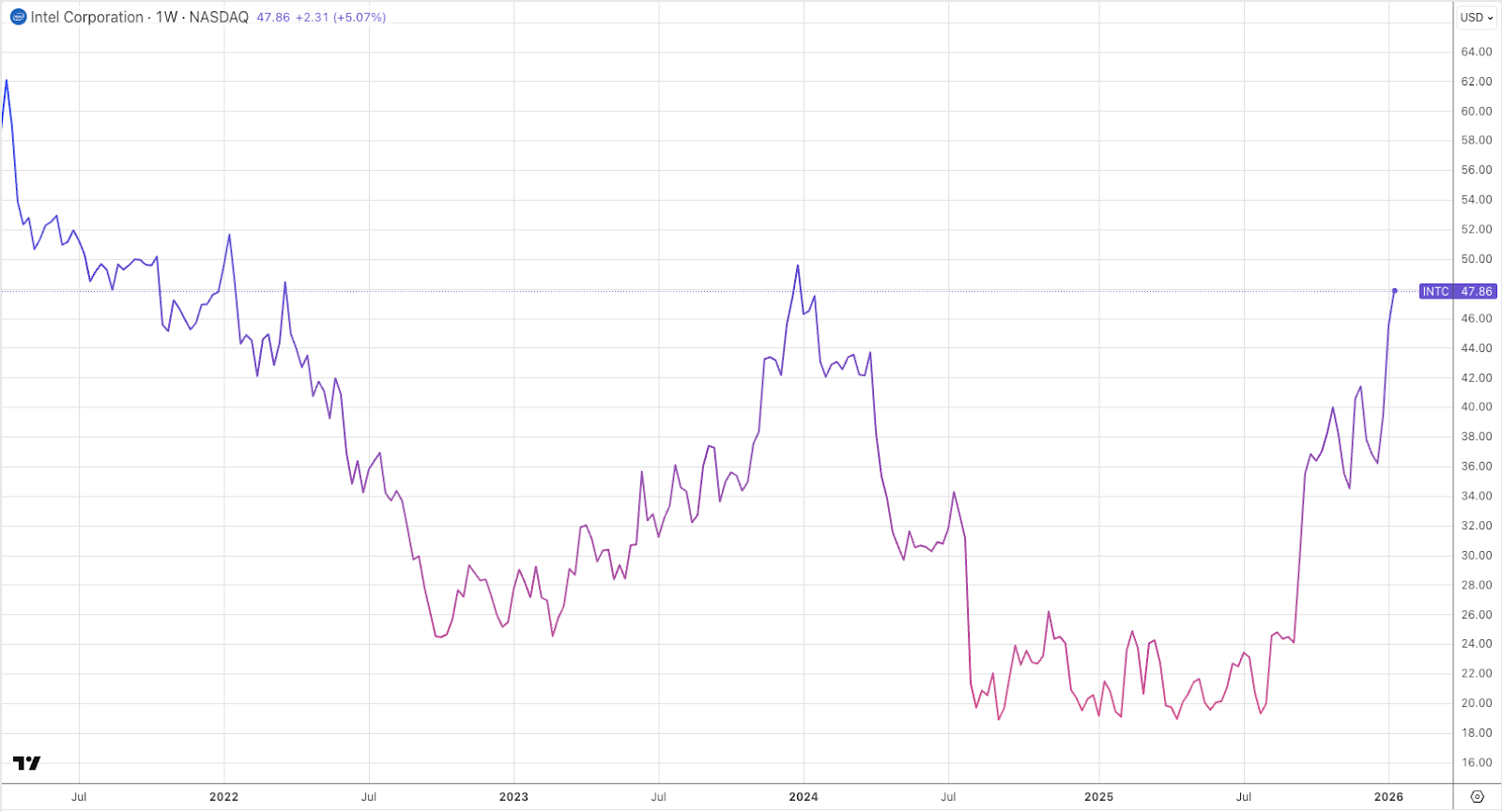
As a result, market anticipation surrounding Intel’s progress with 18A and subsequent technologies has already contributed to increased volatility in Nasdaq index futures. News related to the semiconductor industry’s manufacturing capabilities is therefore likely to remain a key driver of this volatility. As a constituent of the S&P 500 Index, which spans both technology firms and the broader market, Intel’s position further amplifies the market impact of semiconductor-related news.
Intel management views 14A as a key factor for success going forward. During CES 2026, CEO Lip-Bu Tan stated, "We are progressing on the 14A plan," and reiterated that the company will be releasing PDKs (process development kits) for customers in the near future. This will allow Intel to further develop its second-generation RibbonFET transistor technologies and its PowerDirect power delivery solutions while also developing and integrating Turbo Cells into its products, which will allow chip designers to obtain higher operating frequencies without significantly increasing power draw or die size. Ultimately, this will enable Intel to not just catch up with its competitors, but create a story about its technology advancement.
Intel’s primary challenge is not technological, but economic. Historically, the company has deployed technology-driven capacity based on strategic timing rather than firm customer demand. This dynamic becomes more critical as Intel advances toward its 14A process, which will require substantial capital investment in a mix of low-NA and high-NA EUV lithography equipment. At these cost levels, any production downtime becomes increasingly expensive.
Moreover, to ensure sufficient capacity to meet potential large-scale external orders from customers such as Apple, Nvidia, AMD, and Qualcomm, Intel must commit capital early in the development of its contract manufacturing model. This front-loaded investment structure pushes the break-even point further into the future, increasing execution risk during the transition period.
Potential customers and investors have expressed interest in Intel’s new 18A process technology, but remain cautious about its adoption. For example, while Nvidia reportedly explored the use of Intel’s manufacturing capabilities, Intel ultimately declined to move forward with the opportunity. Rather than indicating a rejection of collaboration, this outcome reflects a broader industry pattern in which major semiconductor firms periodically test alternatives to TSMC.
As such, Nvidia’s decision does not suggest a lack of interest in working with Intel. Instead, it highlights the perception that Intel’s 18A process serves primarily as a transitional or “stopgap” technology ahead of the more substantial 14A node. The 14A process is widely expected to represent Intel’s higher-volume and longer-lived offering for external customers.
At the same time, Intel and Nvidia appear to be deepening their relationship through multiple forms of collaboration. One indication is a recently announced agreement, reportedly valued at approximately $5 billion, under which Nvidia RTX chiplets will be integrated into Intel processors for both PC and data-center applications. This collaboration allows Intel to gain operational experience working with Nvidia’s GPU technology and may ultimately enable customers to choose between Intel Arc and Nvidia graphics solutions within hybrid processor platforms.
According to Jensen Huang, the partnership is not new. He has stated that collaboration between Nvidia and Intel began under confidentiality last year and continues to be governed by a non-disclosure agreement.
As a result of recent technological advances and the continued sale of relatively less sophisticated systems in the server market, conditions are emerging for a 10–15% increase in server CPU prices driven by production ramp-ups from Intel and AMD this year. AMD has already demonstrated this shift, delivering approximately a 50% increase in server CPU supply so far this year, largely supported by its Instinct product family and the expectation of up to $15 billion in revenue from AI accelerator sales.
This dynamic has increased pressure on Intel to address its relative shortfall in AI accelerator development by placing greater emphasis on chip production and advanced packaging capabilities. As a result, Intel’s current strategy increasingly resembles an all-in wager. If the company’s 14A technology succeeds, Intel could emerge as a meaningful participant in the contract manufacturing market. If it fails, Intel risks being left with substantial advanced capabilities that primarily serve internal demand, alongside a significantly extended break-even horizon.
For investors focused on Intel’s 14A strategy, the narrative is therefore less about quarterly earnings and more about confidence in the company’s ability to execute a genuine technological turnaround.