
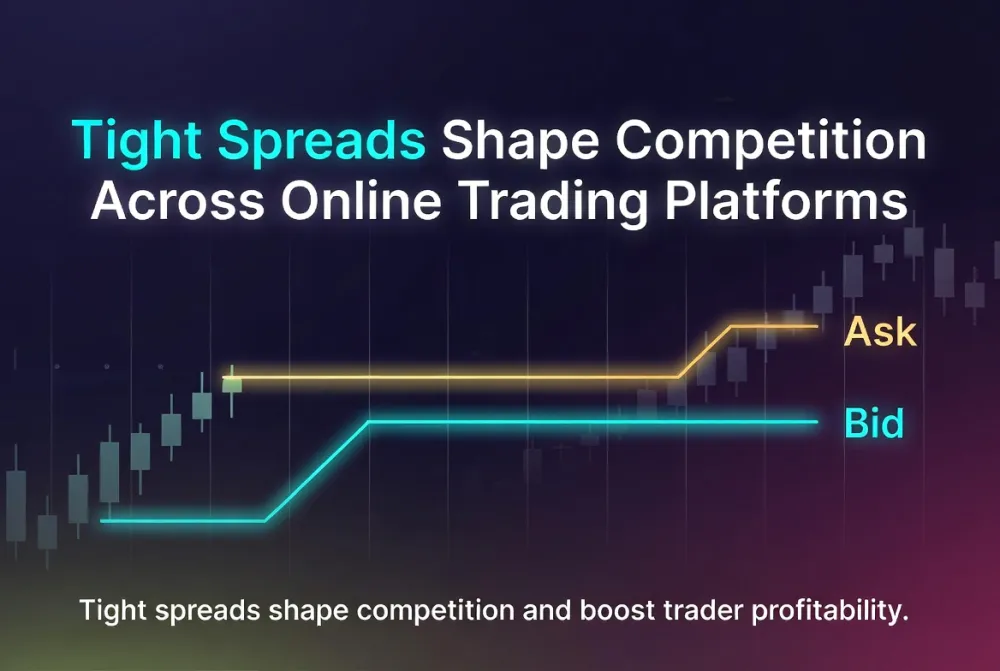
Tight Spreads Shape Competition Across Online Trading Platforms
The tighter the bid/ask spread on an asset, the lower the cost of execution for traders on each trade. If various platforms continue to provide tight bid/ask spreads, they will likely win a larger number of active users and a higher trading volume than platforms that provide wider spreads, due to ease of switching between platforms for active traders.
With traders paying much more attention to execution quality currently than ever before, they compare execution quality based not only on leverage or other aspects of trading such as interface, but also by how tight and stable the spreads are on the instruments they trade most often. Platforms that maintain tight bid/ask spreads will provide their users with a measurable long-term edge that increases incrementally over time as traders continue to make trades on that platform.
I have compared the execution conditions on many different platforms over the years, and the difference between even a fraction of a pip and a couple of cents in the bid/ask spread has the potential to turn a marginally profitable trading strategy into a clearly winning strategy. There should be no doubt that tight bid/ask spreads are, and have continued to become, one of the primary competitive advantages within the online trading industry more than any other single feature.
Let’s look at how tight bid/ask spreads have become a competitive advantage, how platforms achieve tight bid/ask spreads, and how traders can leverage the competitive nature of tight bid/ask spreads to their own personal benefit.
Why Tight Spreads Matter So Much Today
The cost of entering into a trade is always charged as half of the bid/ask difference (i.e., the spread). For scalpers and day traders opening and closing many positions on a day-to-day basis, these costs quickly add up and tend to be one of the largest detractors from profits.
Having tight spreads will reduce your breakeven point for executing your trading strategy. For example, if your strategy has a target of 12 pips with a 1 pip spread, you will only need an 8 pip profit if the spread is 0.4 pips. This single change could be the difference between being profitable and being consistent with your approach/patterns.
Brokers that are stable and consistent will benefit themselves by having the most impact in the market. When a broker has a stable spread, they will have consistent back-testing capabilities, more predictable risk analysis, and will size up positions with confidence since they know that their spreads will not change significantly during the course of the trial period. When the spreads do increase (or decrease) very suddenly, many mechanical trading strategies will no longer work during live trading.
The market has figured this out, and those that invest in better technology and larger amounts of liquidity will provide tighter spreads, thus having the opportunity to attract many more active traders and generate higher total volume on their platforms.
How Platforms Build Tight Spread Infrastructure
Due to various methods of aggregating liquidity from multiple tier-one banks and prime brokers, modern-day trading platforms achieve low spreads due to their ability to foster compelling competition that naturally results in compressed spreads.
The high level of internal order execution volume within the platform improves the depth of the order book. Additionally, having many participants on both sides of the market reduces the difference between the bid and ask price.
Modern-day trading platforms utilize advanced low-latency technology and smart order execution routing to execute trades as close to the actual market price as possible, rather than subjecting the FX trader to delays and/or requotes.
The narrowest spreads occur during times of peak liquidity, with the greatest narrowing occurring during the London/New York overlap. However, superior modern-day trading platforms maintain their competitive advantage by taking advantage of global liquidity pools outside of peak liquidity periods.
The following example illustrates the above statements concisely with regard to how spread widths impact various trading strategies.
| Trading Style | Typical Trades per Month | Impact of Spread Width | Benefit of Reducing Spread by 0.5 pips |
|---|---|---|---|
| Scalping | 1000–3000 | Extremely high | Can turn a losing strategy profitable |
| Day Trading | 300–800 | Very high | Significantly lowers the breakeven point |
| Swing Trading | 50–150 | High | Noticeable improvement in net return |
| Position Trading | 15–50 | Medium | Improves return on larger capital |
This table clearly shows why tight spreads have become a central point of competition between platforms.
How Traders Can Benefit from Tight Spreads
Look at the actual spreads you would experience for your instruments during peaks and troughs of the market instead of relying solely on minimum quoted spreads.
Utilise those actual spreads when formulating your overall trading strategy. Alter what you expect to achieve from your trades by making adjustments based on the profitability and cost of executing trades.
Trade during times when there are natural price adjustments in the marketplace where spreads become tighter. Major overlap periods are good for this, especially for most financial markets.
Utilise limit orders where applicable so you do not pay the full spread at entry and possibly get a better fill.
Calculate your edge based on all costs associated with executing a trade, including the effect of spreads. If you have an average winning trade profiting 10 pips, but the average spread is 0.3 pips, then you will have a significant advantage over trading on a platform that has 1.0 pip spreads.
Monitor spread fluctuations during high-impact economic news events like the release of employment numbers or central bank interest rate announcements, and see how platforms respond to these news events relative to their spreads.
Important Considerations
Spreads typically expand noticeably during high-impact news or low-liquidity periods. Therefore, strategies should consider both these spikes and average values.
Some forex brokers offer tight spreads only on small trade sizes, while larger trades can be expected to experience higher execution costs.
When determining total trading cost (including commissions, swaps, and funding), it is important to keep in mind how high other costs may be when using tight spreads.
Conclusion
Competing in the online trading realm has become defined by tight spreads. Numerous platforms that focus their efforts on providing their users with as much liquidity, technology, and smart routing as possible provide their users with a real benefit.
To take full advantage of these tight spreads, it is essential that you choose a platform that has lower spreads than competitors on the instruments and currencies you trade most often, consider real execution costs in your strategy, time your trades to coincide with the best liquidity periods, and incorporate disciplined risk management when trading. This will allow you to retain more profit from winning trades than you could have done without the elements mentioned above.
In this competitive environment, small differences in execution quality often determine whether a trade is successful or unsuccessful. Choose platforms that have designed their infrastructure around providing their users with tight spreads and have taken this advantage to the next level over time.

