
Why Crude Prices Are Rising
The current US-Iran crisis marks the most serious escalation between the two countries since America's Operation Midnight Hammer on June 22, 2025, which attempted to "neutralize" Iran's nuclear capabilities by bombing three facilities: Fordow, Natanz, and Isfahan.
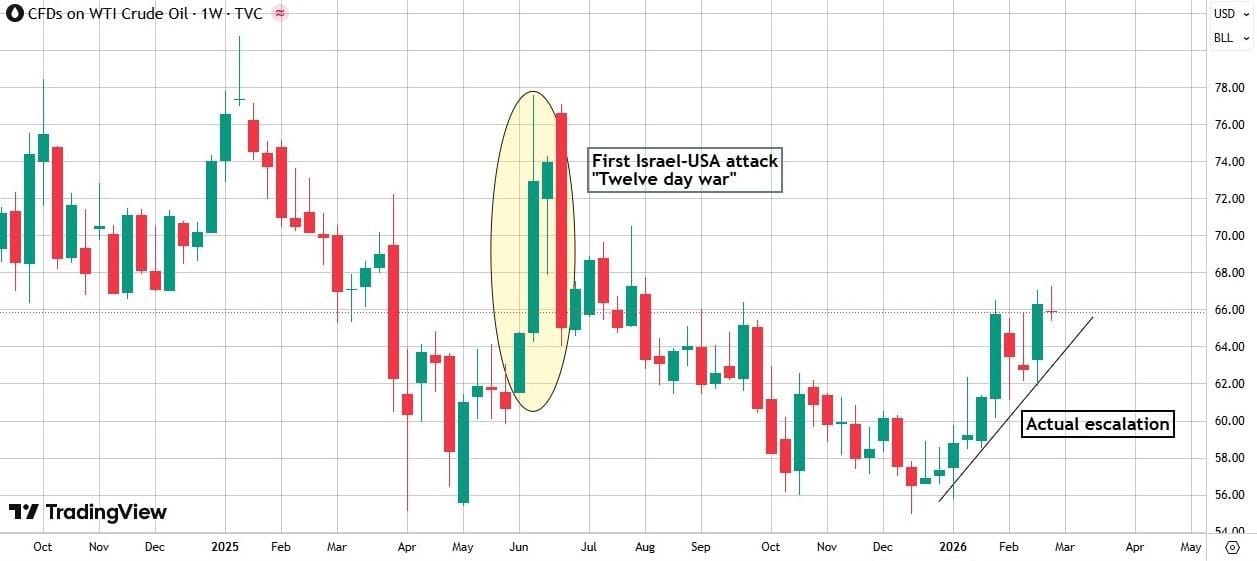
These tensions have pushed crude prices up nearly 20% since the start of the year, reaching $67 per barrel — the highest in six months — despite a fundamentally bearish macro outlook. The oil market remains structurally oversupplied. The IEA's February 2026 report projects demand growth of just 850,000 barrels per day, while supply continues to outpace it. Global observed inventories rose by 477 million barrels in 2025, the highest level since 2020.
The current US-Iran crisis is now being seen by analysts and policymakers as the most dramatic escalation of tensions between the two countries since Operation Midnight Hammer began on June 22, 2026, when US airstrikes were used to try to “neutralize” Iran’s nuclear capabilities by destroying three main sites (Fordow, Natanz, and Isfahan) where those capabilities are located.
Since January 2026, global crude oil prices have risen nearly 20% (to $67/bbl), although the broader outlook for oil prices remains bearish based on weak demand expectations and strong supply fundamentals supporting market balance. The continued increase in observed global inventories (+477 million bbl at end-2025) represents the largest accumulation over any twelve-month period since 2020.
Ongoing geopolitical risk premia continue to support Crude oil prices , with Goldman Sachs estimating the premium at approximately $6 per barrel. If tensions ease, this premium could unwind quickly, resulting in a rapid decline in oil prices similar to the drop that occurred after the previous US–Israeli joint attack known as the “12-Day War”.
In support of the allied campaign, two US aircraft carrier strike groups have been deployed to the region: the USS Abraham Lincoln is currently positioned about 150 miles off the coast of Oman, while the USS Gerald R. Ford is heading toward the Gulf, supported by a substantial deployment of aircraft and missile-defence systems at nearby bases. This represents the largest US military presence in the Middle East since 2003. Iran also appears to have concluded a deal with China for long-range missiles that could be used against adversary aircraft carriers.
Uranium enrichment has been the central issue in the Geneva nuclear negotiations. The United States is demanding that Iran halt all uranium enrichment, whereas Iran maintains that this issue is non-negotiable. An Axios article citing U.S. sources suggests that this may represent the final opportunity for diplomatic resolution before a potential joint U.S.–Israeli military operation against Iran.
The oil market is closely monitoring the Strait of Hormuz, located between Iran and Oman, through which an average of about 20 million barrels of oil per day flows (approximately 20% of global consumption). About 69% of the oil transiting the Strait is destined for China, India, Japan, and South Korea. If the strait were partially closed due to military action or sabotage, the consequences would be severe. Alternative export routes, such as Saudi Aramco’s East–West pipeline, cannot accommodate volumes comparable to those transported through the Strait of Hormuz.
In the CSIS report of February 18 titled “If Trump Strikes Iran,” several escalation scenarios are analysed. In the most severe case, if Iran retaliates following a U.S. strike and manages to keep the Strait of Hormuz closed for weeks, oil prices could rise by more than $90 per barrel. Estimates cited by CSIS from ClearView Energy Partners suggest price impacts of up to $7 per barrel from expanded sanctions, about $13 per barrel from an attack on Kharg Island, and $13–$28 per barrel if the Strait is closed for three to seven days.
According to the Center for Strategic and International Studies (CSIS), it is essential to recognize that a closure of the Strait of Hormuz would also result in Iran's own exports (1.5 million barrels/day) being halted. Iran would be unlikely to close the waterway unless it were cut off from exporting oil, and thus had nothing to lose, which would occur if Iran's regime were attacked by the United States and Israel and left with no options for survival.
With uncertainty about what the impact would be of any military action and a need for the US Government to achieve a victory with no deaths, the main outcome of any military action will either be a partially successful agreement or simply a continuation of current conditions. In this event, the geopolitical premium would disappear, and oil prices would drop back toward baseline forecasts of around $60 per barrel by the end of the year.
If there were limited strikes against Iranian military and/or nuclear facilities and the negotiations break down, Iran would probably respond with some kind of retaliation but not close the Strait of Hormuz. If that occurs, crude prices would initially spike to around $80-$85 per barrel, and subsequently stabilize in the $70-$80 per barrel range. However, if there was a full-blown conflict leading to the closure of the Strait of Hormuz, prices for Brent crude would likely spike to between $90-$120 in the short-term resulting in a significant loss of economic activity across the globe.
The risk of oil prices increasing dramatically is heavily weighted to the upside. The degree to which even a partial closure of the Strait of Hormuz would impact oil prices will be much greater than the degree to which a positive agreement would impact oil prices. The current oil market conditions do not reflect an assumption regarding the possibility of an open conflict occurring. As CSIS states, the significant unknown is whether Iran has lost its ability to export oil. Only when that happens will concern over the Strait of Hormuz become a reality; no parties currently appear willing to take the domestic political consequences of this occurring.

