

Photo by Will Francis / Unsplash
Digital Advertising, Asymmetric Information and Market Efficiency
The Internet is awash in ads, coming at us in the form of pop-ups, banners and posters in the margins or interspersed among articles, and traditional video commercials before our YouTube video plays or mixed into our endless Tik Tok scroll. How does the market for digital advertising work?
Advertising: A Three-Sided Market
Advertisers represent a new addition to the traditional market between buyers and sellers (consumers and producers). Firms hire advertisers to create ads that are featured in the output (usually media) of other firms, creating a business-to-business (B2B) market. Advertisers are “middlemen” in traditional markets that operate between businesses and consumers via media outlets. They appeal to consumers and try to convince them to purchase goods and services on behalf of businesses, and also perform market research on consumer tastes and preferences and spending habits that can be valuable to businesses.
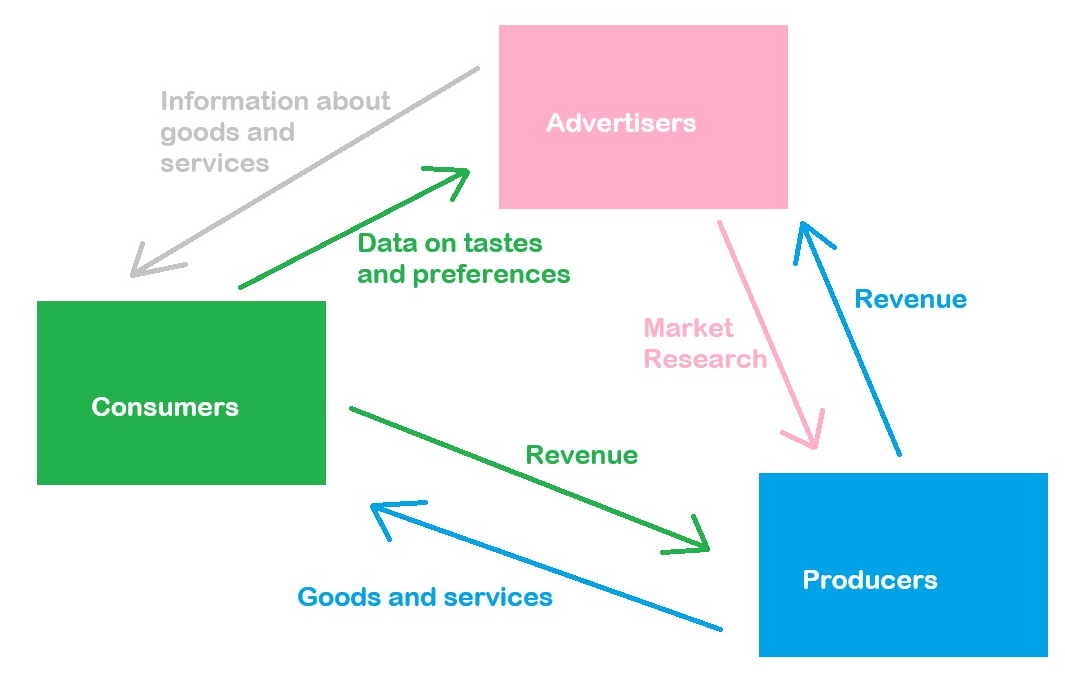
Demand-Side Economic Effects of Advertising
Creation of Public Goods
For some services, such as media, advertisers have come to replace consumer revenue and fund most of all of the cost of production of the producer. Consumers can watch media for free if they are willing to watch advertisements, which may convince them to purchase goods and services from the firms that have hired the advertisers. Or, if consumers do not wish to be subjected to ads, they can pay the media producer a subscription fee to access a higher tier of service where there are no ads.
When advertisers pay for the media output, they create a public good where all consumers with the correct equipment (radio, television, Internet-capable device) can consume the media without payment. Classic examples are radio and network television broadcasts and non-paywall websites. More modern examples include social media and some media-streaming apps and websites, which allow users to join for free but offer paid subscription tiers for those who wish to go ad-free.
Reduction of Information Asymmetry
Advertising can be economically beneficial by informing consumers and producers about market conditions and reducing information asymmetry, which is one of the causes of market failure. When consumers know more about which goods and services are available, they are able to make better consumption decisions and maximize their utility (satisfaction). Similarly, firms are able to make more revenue when they can use market research to make their products more desirable to consumers. Ultimately, good advertising can lead to both consumers and producers benefiting from increased transactions, which is a scenario known as a Pareto improvement.
Adverse Selection and Market Failure
Unfortunately, advertising does not always provide consumers with the information needed to make optimal choices. Adverse selection occurs when one party to a transaction does not have sufficient [accurate] information to make a good choice. Advertising provides information, but it may not be accurate information due to various reasons: errors (unintentional) or deception (intentional). Critics frequently accuse much advertising of being deceptive and not revealing the true costs, true risks of failure, or true conditions of goods and services. This can lead to consumers purchasing goods and services that end up providing much less utility than anticipated.
Credibility Signalling
Some honest advertising reduces information asymmetry, while dishonest advertising can increase information asymmetry through deception. Much advertising in general may be seen as a signal of credibility due to consumers’ assumption that a firm that can afford to advertise prolifically must be successful. While this may be true in many circumstances, such as the largest and most successful corporations, often oligopolies, spending heavily on advertising, other circumstances may feature riskier firms spending recklessly on prolific advertising. Seeing many ads for Coca Cola, McDonald’s, Ford Motor Company, and Apple is indeed a signal of producer credibility, but seeing many ads for a struggling firm that is investing heavily on luring customers is not.
Supply-Side Economic Effects of Advertising
Advertisements don’t just attract customers; they gather data about how viewers interact with those ads. This data can be analyzed by advertisers and producers to make improvements to appeal more strongly to consumers. For example, when a certain advertisement receives much more engagement from viewers than its predecessors, both the advertiser and the producer will study that advertisement to figure out what enticed viewers.
Consumer Reactions Guide Production Choices
By watching ads in their entirety of leaving positive comments, consumers signal that they like what they see. This can lead to improvements in goods and services, especially if positive consumer reaction to an ad campaign is met with a substantial increase in sales. Without advertising, there would be fewer opportunities for consumers to signal their like or dislike of a new product. The lagging indicator of sales revenue would be more difficult to link to changes in product features versus other variables, such as an overall increase in consumer income. Thus, advertising helps producers better understand when a change in product features is driving increased sales.
Click Fraud and Market Failure
However, some ads may not collect accurate viewer or consumer data. Producers have to pay more to advertise on various platforms when those ads receive more engagement, so advertisers have an incentive to maximize viewer engagement…sometimes through deceptive means. Click fraud occurs when various actors artificially inflate the engagement an ad receives, usually to receive some financial benefit. For example, an influencer who is paid to create advertising content may hire a hacker to create bots to continuously play his or her content, making it appear that he or she is a valuable advertising asset and worthy of higher pay rates. In reality, most of the “engagement” on those ads is driven by bots, resulting in no sales.
This deception is the result of a principal-agent problem in digital advertising: Different parties (consumers, producers, and advertisers) have different incentives and goals. The advertiser is not paid strictly based on the producer’s positive increase in revenue after the ad campaign, but rather metrics of engagement from viewers. Therefore, the advertiser wants to maximize clicks, even if doing so is not optimal for the producer’s sales. One example would be creating ads that are highly entertaining, but not necessarily to the producer’s targeted demographic. A car ad may be targeted toward teens who watch in excitement, but lack the finances to ever purchase. In an extreme case, mis-targeted or bot-swarmed ads can result in market failure as the producer relies on products and ads that seem popular but result in few sales over the long run.

