

Photo by 1981 Digital / Unsplash
The Digital Market for Lemons: Information Asymmetry & Signalling Theory in SEO
Remember the early utopian dream of the Internet? The one claiming that infinite digital connectivity would trigger the golden age of human integrity, enlightenment, equality, and democracy.
Where is this dream today? The modern web reality is that everyone is exhausted by the low quality of information. On top of that, a searcher doesn’t suffer from the lack of information; they suffer from its abundance.
We succeeded in creating an ocean of information, but lost its usefulness somewhere on the way. We built the ultimate library of Alexandria, but forgot to hire librarians to guide and explain that not everything you see is noise. Some information is worth your attention; you just need to know how to find it.
This is precisely where search engine optimisation (SEO) must step in.
Analysing the modern web through the lens of two Nobel Prize-winning economic principles—information asymmetry and signalling theory—SEO can become that missing digital librarian, separating the valuable signals from the absolute noise.
The Digital Lemons Problem: Information Asymmetry on the Modern Web
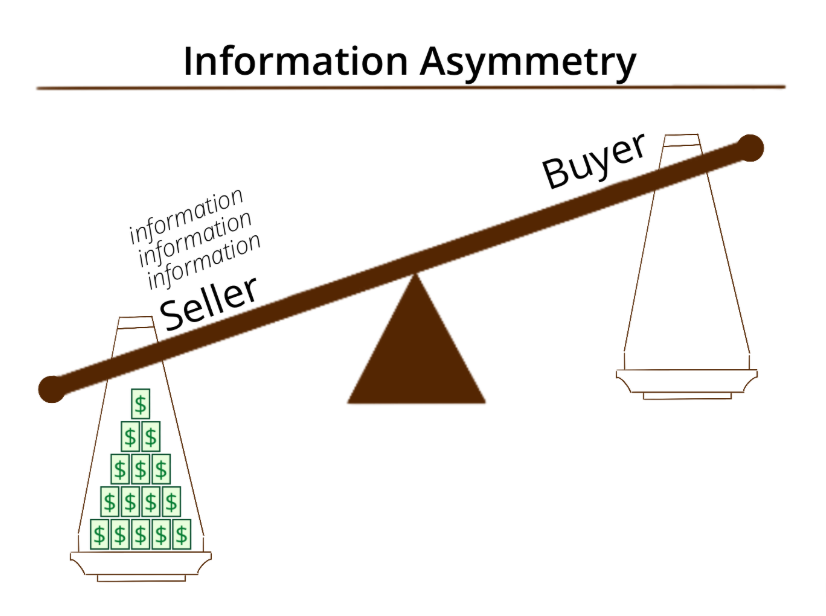
Every time you type a query into a search bar, you exchange a scarce commodity—your time and attention—in exchange for information. But this transaction has one fundamental structural flaw that economists call information asymmetry, a scenario where one party in a transaction possesses significantly more or better information than the other.
The publisher and the owner of the information know exactly what the information they provide is worth. However, you don’t know this upfront unless you actually see and analyse it.
This gap is the exact problem economist George Akerlof identified in his study of market behaviour. Buyers lacking information about goods simply assume that all they find is of low quality (lemons). They are not willing to pay extra for worthy goods (peaches) as they simply have no means of verifying their quality. They naturally begin to anticipate the worst.
Source: Vedantu
On the modern web, the information asymmetry worsens due to the ability of AI to produce tons of low-quality content (lemons), creating a chasm between what a creator and a viewer know. The search results page becomes a crowded place where genuine, hard-earned expertise looks identical to a hastily generated piece of clickbait.
Trust erodes, and this becomes a huge problem for creators of high-quality, authoritative content and for their potential consumers alike.
Signalling Theory: The Power of Hard-to-Fake Badges
If navigating information asymmetry in digital marketing is the defining survival challenge for modern websites, then Michael Spence’s Signalling Theory provides the ultimate antidote.
Spence's approach helps to shift the burden of proof of a good’s or information’s value back to the seller (or creator). The core idea of his theory is simple:
To break through user scepticism, a high-quality player must display a "signal"—a visible credential that instantly establishes brand credibility and verifies their true worth before a single word is read.
However, this is harder to do in practice than it appears in theory. The tricky part is how to prove that a product or content is worth someone’s attention. But Spence has a clear answer to that challenge.
According to his theory, for a signal to successfully bridge the trust gap, it must meet three non-negotiable criteria:
- Asymmetric Cost (The Barrier): The signal must be significantly cheaper or easier for a high-quality player to obtain than for a low-quality competitor. In a labour market, a motivated and capable candidate finds a high-quality university degree challenging but completely doable to obtain. The same degree would be cognitively impossible to obtain for a low-skilled, demotivated candidate.
- Impossibility of Counterfeiting: If a badge of quality can be easily bought, simulated, or faked overnight, its economic value drops to zero. The cost of the signal is what guarantees its authenticity.
- Upfront Visibility: The buyer must be able to view and evaluate the signal immediately, before making the decision to complete the transaction or trust the provider.
The Core Takeaway: In any asymmetrical market, the buyer doesn’t need to determine the value of the product (which usually happens post-purchase)—they look at the cost of the badge the seller is displaying.
The digital world saturated with information favours not those players who shout the loudest, but those who can afford (both economically and capability-wise) to wear a hard-to-replicate, verified badge of competence. This badge sends a powerful signal to potential buyers/consumers, who can instantly recognise the value it contains.
Content Authority as the New Corporate Credential
Similar to how an HR recruiter takes a Cambridge University Master’s Degree as proof of an applicant’s qualifications, in the digital economy, users and search engines apply that same logic to evaluate content. And they do it in a highly creative and efficient way.
Evaluating every paragraph and every line of content is time-consuming and resource-intensive. Because the role of authority in consumer decisions dictates that searchers look for immediate trust shortcuts, search engines ground their assessment in structural signals, relying heavily on a site's topical authority to verify its expertise at a macro level before analyzing individual pages.
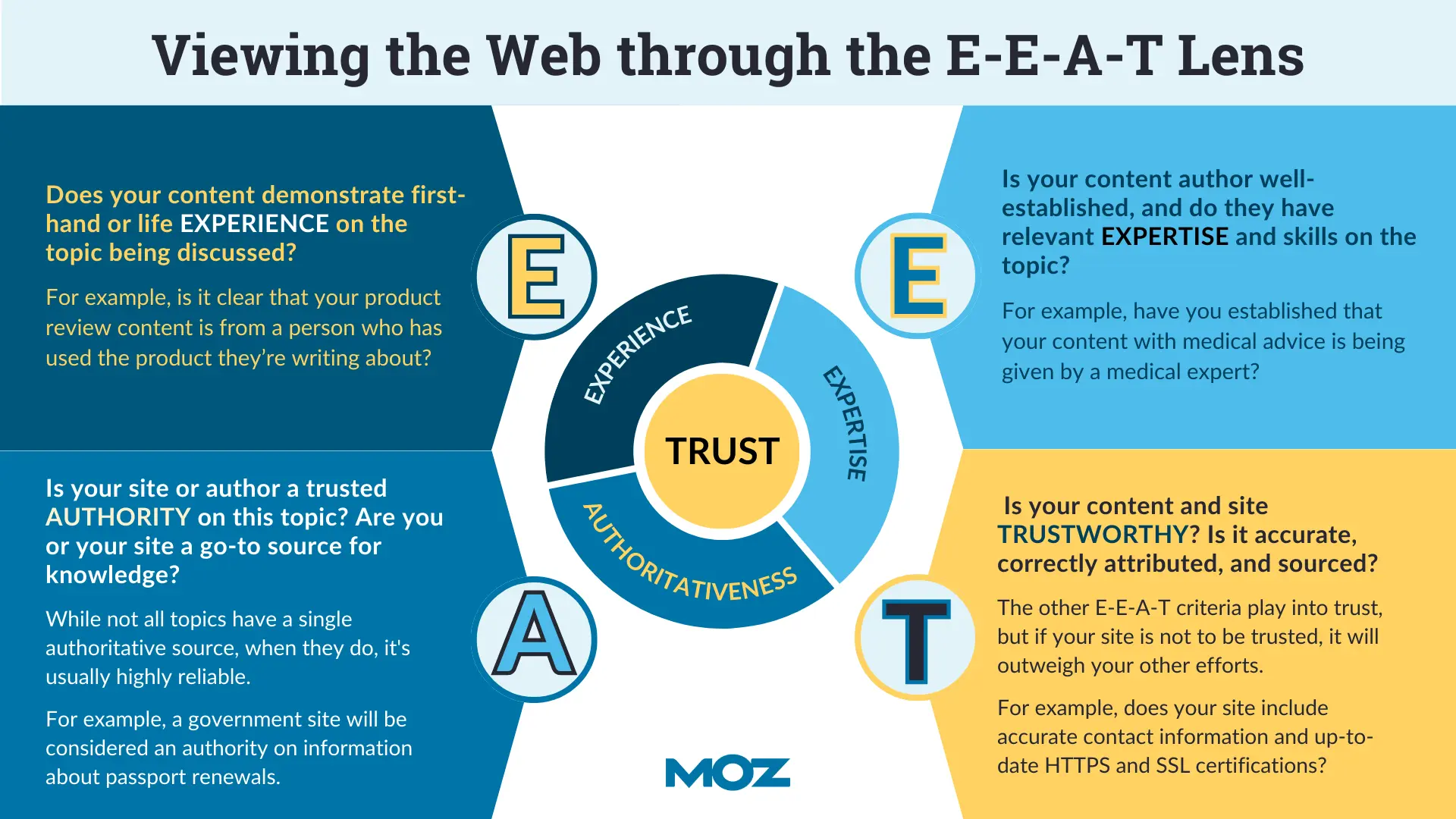
One example of a structural content authority approach is Google’s E-E-E-T framework:
Source: Moz
Essentially, the E-E-E-T framework functions as an algorithmic filtering system for content credentials.
To understand the algorithmic mechanics of how authoritative content builds trust, we can map classic institutional information asymmetry examples from the traditional economy directly to modern digital signals:
- The University Degree → Tier-One Earned Backlinks: Just as a top-tier university risks its reputation by granting a degree, an authoritative site risks its own search equity by linking out. The high cost of the endorsement makes the signal trustworthy.
- The Professional License → Verified E-E-A-T Markers: Similar to how professional licenses work in the economy, an article placed online can feature strong brand trust signals, e.g., a clear, schema-backed author bio, include evidence of a rigorous peer-review process, and contain links to verified professional profiles. This signals real-world expertise to both human readers and search engines’ algorithms.
- The Corporate Track Record → Historical Domain Equity: A brand or a website that has consistently published high-authority, trustworthy information is likely to protect its reputation by continuing to publish quality content. Equally, the domain’s authority cannot be undermined by a single bad publication. The historical consistency of a domain serves as an insurance policy for the search engine.
Why this matters for your content strategy. If your content doesn’t display these hard-to-fake digital authority signals, it is hard for users and search algorithms to evaluate the quality of your blog post, video, or landing page. You may have a really beautiful copy (“peach”), but without the above-mentioned authority metrics, it risks being mistaken for a generic “lemon”.
If you’re still competing on generic volume, you’re playing the wrong game with the wrong strategy. Start fixing your content’s authority, as it’s the only corporate credential that matters in the digital economy.
The Economics of E-E-A-T: Why True Authority Cannot Be Copied
From an economic standpoint, only those signals are effective that have a reasonable cost to deter cheats. Interestingly, if a signal is cheap, everyone can easily use it, but such a signal quickly loses its power.
That's why Google today struggles with ranking content produced by AI. When creating a 20,000-page research project costs a penny and can be done in minutes, the value of content becomes very low. A text is no longer a signal of quality.
To survive, search engines like Google have started to treat E-E-A-T (Experience, Expertise, Authoritativeness, Trustworthiness) seriously. And if you think it's pure theory, we’ll challenge you to reconsider.
Contrary to popular belief, this framework is not just some vague writing guidelines; it’s a strict and algorithmically grounded system of measuring signalling costs.
The Content Economic Divide
The good news and an undeniable plus of authority signals is that they cannot be easily replicated. In fact, content farms struggle to fake true brand authority. To understand why, let’s have a look at how the economics of content creation perform at low and high-quality content, respectively:
Why the "Cost" of E-E-A-T Protects Your Brand
Google’s algorithms scan webpages looking for specific markers of hard-to-fake assets. These could be capital, time required to produce content, and reputation. These markers act as barriers to entry into the league of high-value signals, deterring incapable or unscrupulous players.
Your brand can feel secure if it can naturally signal to Google the following:
- The Sunk Cost of Institutional Trust: Strong brands had to work hard on their reputation. It took them decades to build their names through dedicated work, sound financial and legal compliance, responsible social position, and, of course, the high value of their products and services. Institutional trust is hard to fake, and Google and other search engines know that.
- The Non-Scalability of Genuine Expertise: Expertise is like reputation—it takes effort and time to develop. A talented engineer or a doctor is hard to find and expensive to hire. Content farms just cannot afford to have genuine experts in their teams to produce high-quality texts.
- The Friction of Earned Mentions: Similarly, acquiring editorial backlinks from reputable publications takes serious outreach effort, plus it’s expensive. True authority often manifests first as unlinked mentions across high-tier publications—organic brand citations that serve as a strong signal of market trust before they are even converted into formal hyperlinks.
Capitalising on these signals requires genuine relationship-building, which is a structural cost a spammer simply cannot afford.
Building authentic topical authority takes time, effort and money. It can only be earned through hard work and strategic effort. Your competitors cannot easily replicate the successful reputation of your company, nor can they easily scale using your best practices.
The Bottom Line
The roles of two economic theories, information asymmetry and signalling theory, don’t diminish over time. On the contrary, it continues to solve social and economic problems not only in marketing, but also in modern SEO.
The informational asymmetry can be successfully extrapolated to content marketing, which currently suffers from the abundance of low-quality, AI-generated texts (“lemons”). In other words, this theory explains why users or consumers tend to treat all information available online as low quality.
As a result, creators of high-quality content (“peaches”) cannot find their consumers and are doomed to degrade over time.
The solution to this problem comes from the signalling theory. In the case of digital space, creators of high-quality information should focus on generating relevant authority signals, which get picked by search engines like Google as the primary criteria for sorting the web. This theory rescues high-value "peaches" from being drowned out by the informational noise.
If you’re a content producer in this noisy space, you must focus on earning the following three credentials: editorial backlinks, E-E-A-T markers, and domain equity. These brand authority signals are your hard evidence that proves your worth in a fundamentally sceptical market.

