
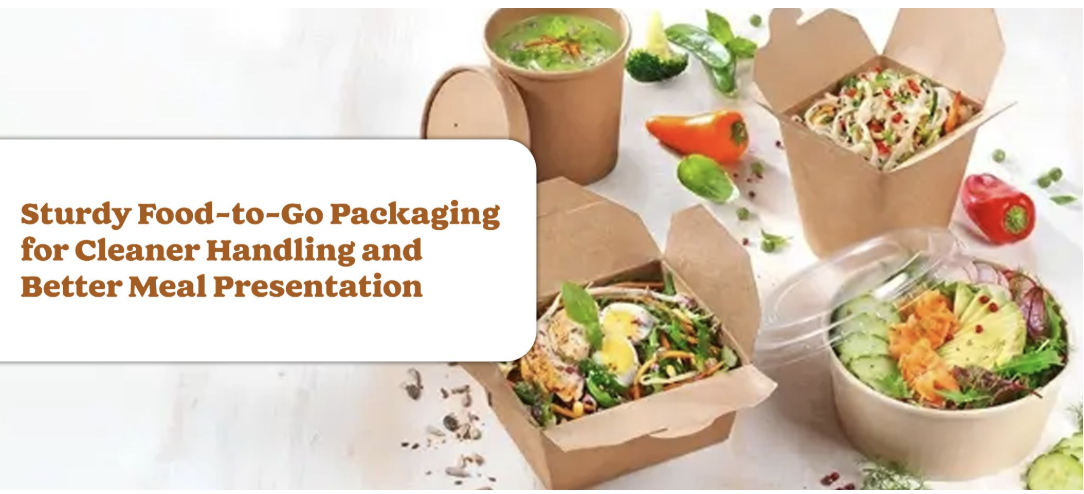
Sturdy Food-to-Go Packaging for Cleaner Handling and Better Meal Presentation
Economies of scale are an economic principle whereby, as output increases, the average cost of producing each unit tends to fall. This is particularly relevant to food-to-go businesses, where fixed costs such as design, tooling and artwork setup can be spread across more units, while larger order volumes can also improve buying power. Packaging is one of the clearest areas where businesses can see economies of scale in practice, as the difference between an efficient and inefficient order can show up directly on the invoice.
What Are Economies of Scale in Food Packaging?
In food packaging, economies of scale arise when ordering larger quantities reduces the average cost per unit. Suppliers can often offer better unit prices at higher volumes, while setup costs are spread across a greater number of packages. However, ordering more is not automatically more efficient: if a business orders far more packaging than it can use, storage costs, waste and cash tied up in inventory can outweigh the initial savings.
How Fixed Costs Fall as Order Volume Rises
Every custom packaging run carries fixed costs that do not change whether a business orders 1,000 units or 50,000 units. These can include artwork setup, plate or cylinder costs, and supplier tooling for a bespoke shape. At low volumes, these fixed costs dominate the price per unit. At higher volumes, they are diluted across far more items, which is why unit prices drop sharply once an order crosses certain thresholds.
This is why writing a clear, realistic product brief matters before approaching a supplier. A brief that accurately captures expected order volumes, seasonal peaks and reorder frequency allows a business to order at a scale that actually reduces cost, rather than overpaying for a small run or overcommitting capital to stock it does not need.
Matching Burger Box Structure to Real Demand
The structure you choose, whether vented clamshells, lockable food-to-go boxes or simple carton types, should follow the same thought process. A completely custom-made structure will only provide a scale benefit if the business can guarantee sufficient volume to justify the initial investment in tooling. If a business orders a custom-built structure at a low volume, the high fixed costs may negate any potential savings. Therefore, testing filled prototypes of the different formats before making a decision helps to ensure the format selected meets both the product and order-quantity requirements, rather than choosing a format that is only cost-effective at a scale the business has not yet reached.
A defined, purpose-built format such as Burger Boxes illustrates this well: because it is engineered specifically for hot, filled, short-hold products, a business ordering it at scale avoids paying for generic, over-specified alternatives while still getting a structure suited to consistent daily use.
Why Standardising Packaging Multiplies the Saving
When companies adopt a consistent approach to packaging across their product lines instead of creating numerous variations (SKUs), they can achieve greater economies of scale. Multiple variations on the same product may mean that there are multiple setup costs and minimum order quantities, so a consolidated packaging matrix makes it easier to see what can be combined into one format. Additionally, having common branding guidelines allows for the reuse of digital files and tools, resulting in fewer production lots and larger order volumes, which can further reduce the average cost per package.
How Buying Power Improves With Order Scale
By taking advantage of economies of scale, businesses can increase their negotiating power with suppliers. Larger and more consistent orders can typically help businesses secure better prices, longer lead times and improved service terms. Suppliers can also manage their production cycles more efficiently when they have a known and repeatable order commitment.
When Economies of Scale Turn Into Diseconomies of Scale
Economies of scale are not unlimited. Ordering far beyond realistic demand to chase a lower unit price introduces new costs: storage space, working capital tied up in unsold stock, and the risk of holding packaging that becomes obsolete if a menu or brand detail changes. This is the point where diseconomies of scale begin to outweigh the savings. The efficient order size sits where the falling unit cost from volume is balanced against the rising cost of holding and financing that stock.
Forecasting realistic order volumes, rather than ordering the maximum a supplier's discount tier allows, keeps a business on the efficient side of that balance.
Turning Economies of Scale Into a Packaging Process
Applying economies of scale well requires operational discipline: an accurate brief, tested structures, and standardised formats across a range. None of this requires guesswork. It requires treating packaging volume as a genuine planning input, reviewed alongside sales forecasts, rather than a figure chosen on the day an order is placed.
Conclusion: Ordering Burger Boxes at the Right Scale
Two companies may buy the same or similar packaging yet pay very different prices per unit because one has completed its due diligence, planned its volumes and standardised its packaging assortment. Based on experiences with food-to-go businesses in the UK, businesses need to realistically forecast their needs, standardise their products where it makes sense, and buy their volumes in a manner that maximises the efficiency of their fixed costs without creating too much excess product.

