

Photo by Simon Kadula / Unsplash
Marginal Efficiency of Capital: Definition and How It Works
The marginal efficiency of capital (MEC) is the expected rate of return from an additional unit of capital investment, a term Keynes introduced to explain why and how much firms invest. The firm estimates the stream of revenues an asset is expected to generate, then finds the discount rate, the percentage used to convert future money into today's worth, at which the present value of that stream equals the asset's supply price, what it would cost to produce or replace. That discount rate is the marginal efficiency of capital.
How the Marginal Efficiency of Capital Determines Investment
The MEC links the expected return on investment to the interest rate. If a project's MEC exceeds the interest rate, the expected return covers the cost of financing and the firm invests; if the MEC falls below the interest rate, the project is rejected.
How to Calculate the Marginal Efficiency of Capital
Consider a machine with a supply price of £10,000, expected to yield £11,200 after one year. The MEC is the discount rate equating that £11,200 to the £10,000 supply price:
At a 6% borrowing rate, the 12% return clears the hurdle and the project goes ahead. At 14%, the same project is rejected, though nothing about the machine has changed.
The image below illustrates this principle. The MEC curve slopes downward for two reasons: diminishing returns, as each extra machine adds less output than the one before, and firms taking on their most promising projects first, leaving lower-return opportunities for later. Both push the expected rate of return down as investment rises. The interest rate is shown as a horizontal line, with its intersection with the MEC curve indicating the equilibrium level of investment. Investment projects to the left of this point have an MEC above the interest rate and are therefore profitable, while projects to the right have an MEC below the interest rate and are not profitable at the prevailing interest rate.
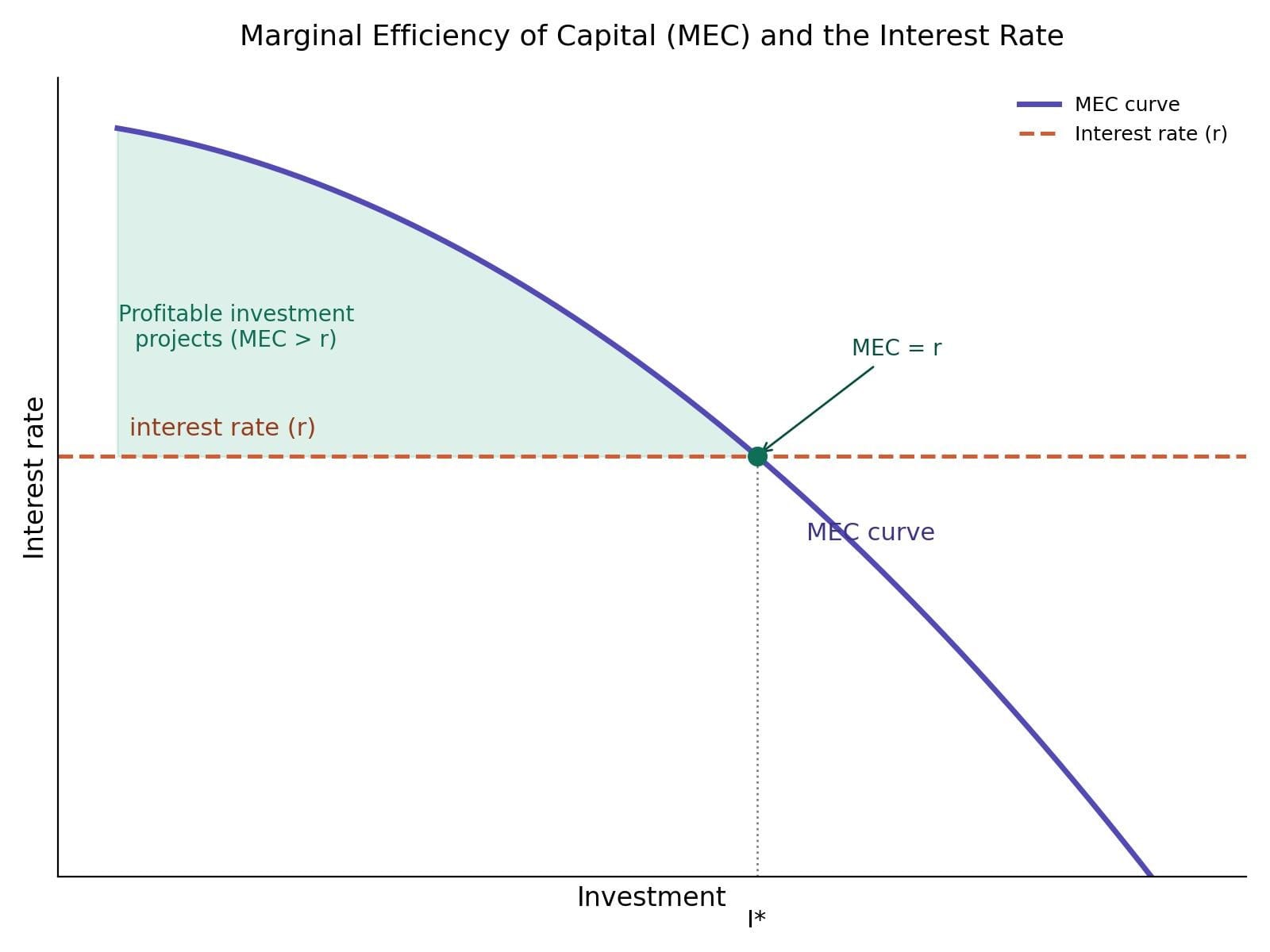
The downward-sloping MEC curve and interest rate, showing the equilibrium level of investment where MEC equals the interest rate.
What Causes the MEC Curve to Shift?
The main driver is business expectations. Optimism about future demand raises expected profitability, shifting the MEC curve outward and making more projects worth undertaking at any given interest rate; pessimism, rising costs or greater uncertainty shift it inward, limiting investment even when the interest rate is unchanged.
How Interest Rate Changes Affect Investment
A change in interest rate does not shift the MEC curve. It simply alters the horizontal interest rate line, leading to movement along the MEC curve resulting in a new amount of investment. If the interest rate goes up, the projects whose MECs lie between the old and the new rates cease being profitable, and investment drops. On the other hand, if the interest rate goes down, the projects which were marginal before become profitable.
MEC and the Accelerator Effect
The MEC is also relevant to understanding the accelerator effect. While the MEC helps determine the level of investment firms are willing to undertake at a given interest rate, the accelerator effect suggests that faster output growth can stimulate additional investment by increasing expected future returns and shifting the MEC curve outward.
Marginal Efficiency of Capital vs Marginal Efficiency of Investment
The marginal efficiency of investment (MEI) is closely related but not identical. MEC holds the supply price of capital goods constant; MEI recognises that when many firms invest simultaneously, that price is bid up, lowering the expected return on each project. The MEI curve is therefore steeper: a given fall in interest rates raises actual investment by less than the MEC schedule alone would suggest.
MEC and the Marginal Productivity of Capital
It is important to note that MEC is different than the marginal productivity of capital (i.e., the amount of extra output produced by adding additional capital), as the latter measures the financial return you could expect to receive by investing money into capital; therefore, it is possible for an investment to increase output while at the same time not justify the cost of the investment based on the expected financial return.
