

Editorial illustration by author
Why Bitcoin’s Supply Cap Does Not Keep Its Price Stable
New issuance adds to that stock over time, but its schedule does not accelerate just because buyers become more eager. Existing holders can respond by offering more coins, and buyers can respond by accepting higher prices. These responses affect trading conditions without changing the cap.
Demand can shift independently of that issuance schedule. On September 10, 2026, AlphaWire reported that US spot Bitcoin exchange-traded funds recorded US$166.8 million in combined net outflows over two days, citing Farside Investors. This measures just one withdrawal of investment through one fund channel, not total Bitcoin trading, but it’s a useful example of the process.
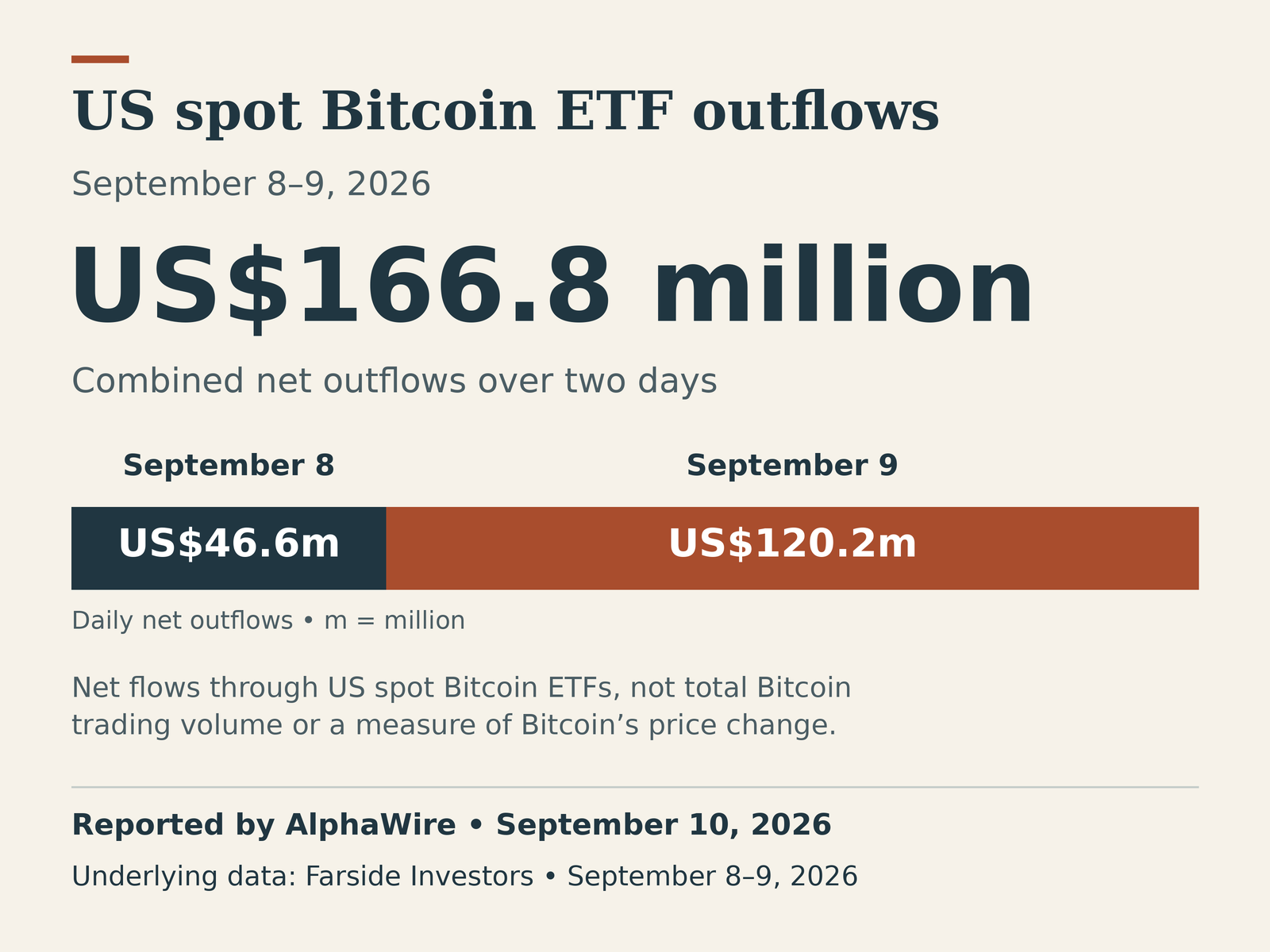
The supply cap remained the same through those changes. A limit on coin creation places no corresponding limit on how quickly investors can change their interest in holding Bitcoin. Nor does it require new buyers to replace investors who reduce their exposure.
How bids and offers move Bitcoin’s price
On an exchange, a bid states what a buyer will pay, while an offer states what a seller will accept. A trade occurs when an order matches an available price. The quantity available close to the current price affects how far an incoming order may have to reach to complete its purchase or sale. Buying can absorb the lowest available offers, leaving higher prices for subsequent purchases unless sellers supply more coins at the earlier levels. Selling can absorb the highest bids, leaving lower prices unless buyers replenish them. Both processes concern orders for existing Bitcoin. Neither requires the creation of additional coins.
An owner’s willingness to sell is also conditional on price. Holding through one price level does not imply refusing every higher offer. Similarly, a buyer willing to purchase at a lower price may decline to buy after a rise. The market adjusts through these changing choices, rather than through a collective decision by everyone who owns Bitcoin.
The latest traded price is not a price guaranteed to every holder. A completed transaction establishes what its participants accepted for that quantity. It does not establish how much buying interest would remain if many other owners tried to sell. An unchanged total supply cannot answer that question.
The amount available for immediate trading is often described through market depth: the buying and selling orders available at different prices. A large stock of existing coins does not automatically produce deep markets. Coins held without active sale orders do not fill a buyer’s order simply because they exist. Orders can also change before a trade happens. Sellers can withdraw offers or alter their prices, and buyers can lower their bids. Yesterday’s available supply at a given price is not a promise about what will be available today.
Inactive holdings can return to the market
Holding periods provide evidence about past behavior, with limits on what they reveal about future sales. A coin that has stayed unmoved can subsequently move. Its earlier inactivity does not become a restriction on the owner’s next decision.
Glassnode’s September 9, 2026 report described how existing coins were distributed across estimated acquisition prices, using data through September 7. Its model showed growth in supply associated with acquisition prices between US$76,000 and US$82,000, while supply associated with US$62,000 to US$65,000 diminished as coins moved out of that group. This concerns the distribution of existing holdings across acquisition prices, rather than an increase in Bitcoin’s maximum supply.
Such estimates come from analysis of blockchain records. They are not a complete list of exchange orders, and a coin’s movement does not by itself reveal its owner’s future asking price. Holdings data and trading availability therefore answer related but separate questions.
Scarcity constrains the creation of new units. Price stability would also require buyers’ willingness to pay and sellers’ willingness to sell to remain sufficiently balanced around similar prices. Bitcoin’s issuance rules do not enforce that balance. Knowing the cap explains why supply cannot expand without limit; understanding a price change requires examining demand and the existing coins available at the prices buyers will pay.

