
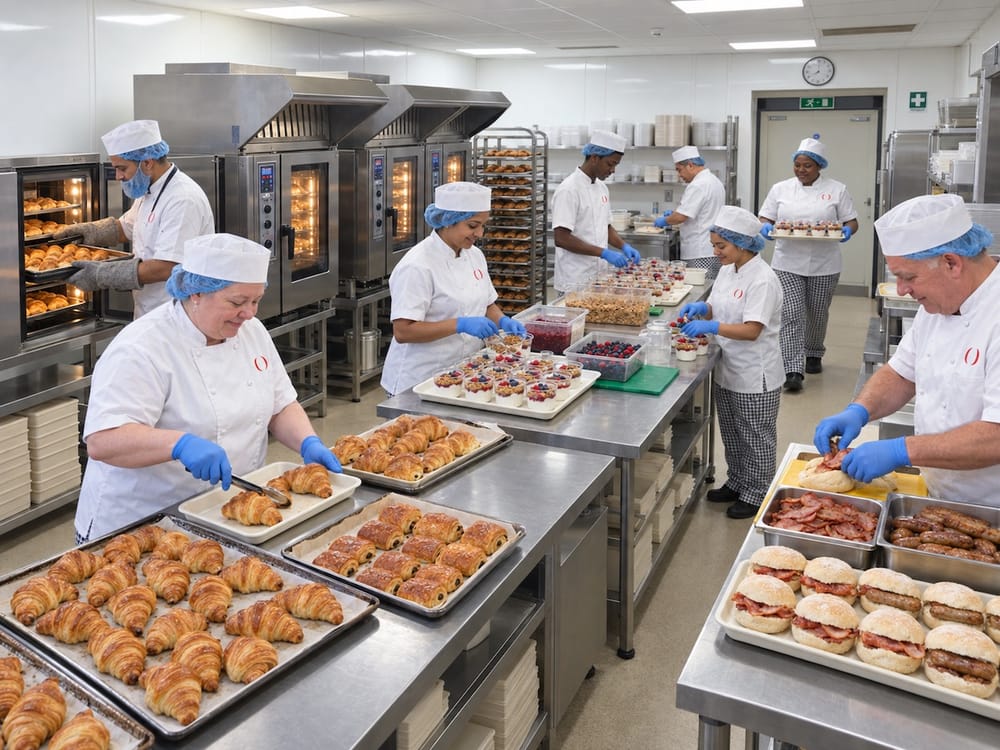
Chefs in an industrial kitchen preparing baked goods like croissants, pain au chocolat, and sausage and bacon baps
How Is Derived Demand Reshaping the Workday Lunch Economy?
Hybrid working has made demand for workday lunches depend on which days staff come into the office, so lunch spending in city centres across the UK now rises and falls with office attendance rather than following a steady five-day pattern.
Why Does Lunch Demand Follow Office Attendance?
Few people travel into a city centre just to buy lunch. Spending on workday food comes from being at work, which makes it a form of derived demand: demand that exists because of demand for something else.
In a demand diagram, the number of workers in the office is one of the conditions of demand. When attendance rises, the demand curve for city-centre lunches shifts to the right; when it falls, the curve shifts left. Hybrid working means that shift now happens within a single week. The Office for National Statistics (ONS) found that 28% of working adults in Great Britain were hybrid working in autumn 2024.
What Happens When Demand Peaks Midweek?
Attendance is not spread evenly. Analysis of City of London station exits by Centre for Cities found Thursday was the busiest day and Friday the quietest, with Friday exits around 64% of Thursday’s before Christmas 2023. Comparable figures for cities such as Manchester, Birmingham and Leeds are less widely published, but the London data shows how uneven hybrid demand can be.
For a café, this creates a cost problem. Rent, equipment and core staff are fixed costs that must be paid every day. On a busy Thursday those costs are spread across many customers, so the average cost of each lunch is low. On a quiet Friday the same costs fall on far fewer sales, pushing average cost up and squeezing profit.
Uneven demand also creates capacity problems. A shop sized for the Thursday rush has idle staff and counter space for much of the week, while one sized for an average day turns customers away at the peak.
How Can Food Businesses Respond?
Economic theory offers a guide to quiet days. In the short run, a business should stay open as long as revenue covers its variable costs, such as ingredients and hourly wages, because the fixed costs must be paid whether it opens or not. If a Friday cannot cover even those variable costs, closing early or not opening at all reduces losses.
Businesses can also use off-peak pricing, offering discounts or loyalty deals on Mondays and Fridays to attract price-sensitive customers when spare capacity would otherwise go unused.
Part of the problem lies in location. City centres attract food businesses because of agglomeration economies: a dense cluster of workers creates a large market within walking distance. Hybrid working weakens that advantage on the days the cluster thins out.
Why Do Employers Buy Lunch for Office Days?
Employers face their own demand problem: persuading staff that a day in the office is worth the commute. Lunch helps because a shared meal and a day of in-person work are complementary goods, each making the other more valuable.
Ready-to-eat meals reduce the employee's cost of coming to work, as the worker no longer has to pay for lunch, but also provide more value to the employee because they allow informal conversation during lunchtime and during breaks. By reducing costs and allowing informal conversation, employer-provided meals enhance the value of an in-office workday compared with working from home.
Why Outsource Instead of Running a Canteen?
A permanent canteen carries high fixed costs, such as kitchen space, equipment and salaried staff. Suppose, as an illustration, a canteen costs £1,500 a week to run regardless of use. If 300 meals are served, the fixed cost per meal is £5. If attendance halves to 150 meals, it doubles to £10.
Ordering food only when needed turns that fixed cost into a variable one that rises and falls with headcount. In Manchester, for example, businesses can use South Catering's corporate catering and other local caterers to order for a specific meeting, training day or team day, paying in line with the number of people expected.
Why Does Uncertain Headcount Cause Over-Ordering?
Ordering to demand only works if demand can be forecast, and hybrid working makes headcounts less predictable.
The two possible mistakes do not cost the same. When the cost of running short seems cheaper than running long, it is rational to over-order. Consequently, after large meetings, it is common to see a number of untouched platters left over from the meal service. However, when too little food is ordered for colleagues, they do not have lunch, which defeats the purpose of the meeting. In addition, ordering too much food leads to waste in both food and money.
Better information narrows the gap. Desk-booking systems, fixed team days and ordering closer to the date all reduce forecasting error, lowering both waste and cost.
The workday lunch economy is unlikely to return to its pre-pandemic shape. Demand that once arrived five days a week now arrives in midweek peaks, and both employers and food businesses are adjusting their costs to match.

