

Photo by Rafik Wahba / Unsplash
What Is the Mansion Tax? How the High Value Council Tax Surcharge Works
The mansion tax is the popular name for the High Value Council Tax Surcharge (HVCTS), a recurring annual charge on owners of homes in England valued at £2 million or more. It will cost £2,500 to £7,500 a year depending on value and is due to start in April 2028.
The Budget of 26 November 2025 announced the surcharge, and a government consultation that ran from 19 May to 14 July 2026 set out its proposed design. That design is not final, and the Autumn Budget on 28 October 2026 could change it.
How Does the Mansion Tax Work?
The surcharge is paid on top of council tax. The Valuation Office Agency, part of HM Revenue & Customs, will value each qualifying home at its 2026 market value and place it in one of four bands, each with a fixed annual charge. The table and chart below show the bands and the number of homes the OBR expects in each.
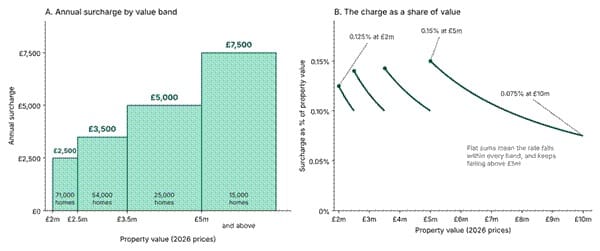
Fig. 1 — The annual surcharge in each value band (A) and the surcharge as a share of property value (B). Because the charges are flat, the effective rate falls within every band.
Local authorities will bill and collect the surcharge alongside council tax, with first bills expected in March 2028. The revenue will go to central government rather than staying with councils, according to the OBR, although the consultation says it will support funding for local government services, and councils will be fully compensated for the cost of collecting it. The charge rises each year in line with consumer price inflation (CPI), and homes are to be revalued every five years, with the next revaluation in 2033. The OBR expects the surcharge to raise a net £400 million in 2028-29. That is about a third below its static estimate of £605 million, because owners, buyers and builders are expected to change their behaviour.
Who Pays the Mansion Tax?
The legal owner of a home valued at £2 million or more pays the surcharge, not the occupier. Joint owners are jointly and severally liable, so any one of them can be pursued for the full charge, but it is payable only once per home. Companies that own homes are liable too. The OBR estimates that 165,000 homes would be liable in 2028-29 before any change in behaviour, or 156,000 after it (OBR, 2 April 2026). The government says this is fewer than 1% of residential properties in England. That sets the scale of the policy: it is a narrow tax on a small group of owners, not a general tax on housing.
The group is also concentrated. The OBR publishes no regional split. Analysis by the property firm e.surv, based on its 2025 valuation model, puts almost 89% of homes worth over £2 million in London (66.4%) and the South East (22.4%).
Why Do Economists Prefer Recurring Property Taxes to Stamp Duty?
Most economists argue that recurring property taxes distort decisions less than transaction taxes. Stamp duty land tax (SDLT) is charged every time a home is sold, so it raises the cost of moving and discourages some people from moving at all. Homes then stay with owners who value them less than other potential buyers would, such as older owners in family-sized homes who would otherwise downsize. That lost gain from trade is a deadweight loss, as Fig. 2 shows.
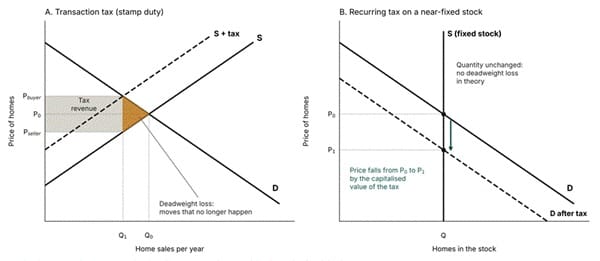
Fig. 2 — A transaction tax such as stamp duty cuts the number of sales and creates a deadweight loss (A). A recurring tax on a fixed stock of homes lowers prices but leaves the number of homes unchanged (B).
Worked example: A buyer who owns no other home pays £153,750 in SDLT on a £2 million purchase at standard rates. The lowest surcharge is £2,500 a year, so the SDLT bill equals 61.5 years of surcharge (£153,750 ÷ £2,500).
The comparison is not like-for-like, because SDLT is paid once by the buyer, and the surcharge is paid every year by the owner. An owner who stays for 20 years in the lowest band pays £50,000 in total (20 × £2,500), before CPI uprating. The key difference is what each tax discourages. Stamp duty penalises moving, so it blocks trades that would make both buyer and seller better off. The surcharge is due whether the owner moves or stays, so it leaves that decision largely untouched, which is why economists see stamp duty as the more damaging tax for the housing market.
The Mirrlees Review concluded that SDLT should be abolished and council tax reformed so that payments are proportional to up-to-date property values. It called the reformed council tax a housing services tax. It also proposed a land value tax, a charge on the value of land alone, for business and agricultural land. The logic is that land is fixed in supply, so taxing it cannot reduce the amount of land available and does not discourage building on it.
The surcharge is not a land value tax. It is charged on the total value of the property, including the building, so it can still affect building decisions: the OBR expects it to reduce the rate of new building above the threshold by 10%.
Who Bears the Cost of the Mansion Tax? Incidence and Deferral
Tax incidence describes who ultimately bears a tax, whoever receives the bill. Because the supply of existing homes is highly inelastic, owners cannot respond to a recurring charge by supplying fewer homes, so the cost falls on them through a lower sale price: buyers offer less to allow for the future charges. In theory the tax is capitalised as soon as buyers expect it, so the loss falls on whoever owned the home at announcement in November 2025. The OBR’s forecast phases that price effect in from 2028-29.
Worked example: At the OBR's 5% discount rate, a permanent £2,500 a year has a present value of £50,000 (£2,500 ÷ 0.05). That is 2.5% of a £2 million home's value. This simple perpetuity ignores CPI uprating, which would raise the figure.
Capitalisation does nothing for owners who are asset-rich but cash-poor, because they still face a cash bill every year that bears no relation to their income. The consultation therefore proposes deferral for main homes. Eligibility would rest on two tests (household income of £35,000 or less and savings of £16,000 or less), and the consultation asks whether meeting either one should be enough. Homes where someone is disabled or severely mentally impaired would also qualify, while second homes and company-owned homes are excluded. Deferred charges would become a debt, with interest at a rate still to be set (the consultation floats options between 3.75% and 4.75%). A change of ownership would be the default point of repayment. Deferral therefore turns an annual tax into a claim on the home's value at sale. It eases cash flow but not the loss of wealth.
Is the Mansion Tax Fair?
A proportional tax takes the same percentage of every home's value. The surcharge does not. A charge of £2,500 on a £2 million home is 0.125% of its value, but £7,500 on a £10 million home is 0.075%. Flat charges mean the effective rate falls within every band and continues to fall above £5 million, as Fig. 1B shows. Measured against property value, the surcharge is therefore regressive within each band and across the top band.
The government's case rests on the council tax gap. The consultation compares a Band D home worth about £400,000 in Darlington or Blackpool, which pays £2,400 to £2,600 a year (0.6% to 0.65% of value), with a £10 million Mayfair home paying about £2,100 (about 0.02%). Adding the surcharge lifts the Mayfair bill to about £9,600, or roughly 0.1% of value. The gap narrows but does not close. (Percentages are EO calculations from the consultation's figures.)
Bands also create cliff edges. A home valued at £1.99 million pays nothing, while one valued at £2 million pays £2,500 a year. The OBR assumes some valuations bunch just below each threshold, which cuts the number of homes charged by 1.5%. Knight Frank estimates that 73,600 homes are worth between £1.8 million and £2.2 million, a valuation “grey zone” where the exact figure decides who pays.
This is the equity-efficiency trade-off: policies that improve fairness can reduce efficiency. Supporters argue that property wealth is unevenly spread, as a Lorenz curve can show, and that owners of the most valuable homes can afford a larger contribution. Critics point to the cliff edges, the valuation disputes and owners who may be forced to sell.
Will the Mansion Tax Threshold Change? Fiscal Drag and the £1.5m Proposal
Fiscal drag happens when a tax threshold stays fixed while prices rise, so more people are pulled into the tax without any change in the rules. The charges rise with CPI, but the £2 million threshold does not. The consultation suggests any change to the thresholds would be considered at future revaluations, leaving the decision to later governments.
Worked example: The OBR's house price index rises from 105 in 2026-27 to 117 in 2030-31, about 11%. A home worth £1.8 million in 2026 that tracked it would be worth about £2.0 million by 2030-31. Unless the threshold is raised, that home would be at or above £2 million when valuations are next refreshed in 2033.
Chancellor John Healey will deliver the Autumn Budget on 28 October 2026. Press reports in July and September 2026 said a £1.5 million threshold was under consideration, and the government has not confirmed it. Tax Policy Associates estimates that a £1.5 million threshold would catch about 245,000 homes, against about 123,000 at £2 million (its baseline differs from the OBR’s). That would put about 85% of the newly caught homes in London and the wider South East, or about 77% using today’s official London and South East regions.
