

Photo by Bozhin Karaivanov / Unsplash
Microeconomics vs Macroeconomics: What's the Difference?
Correct as of 18 September 2026.
Microeconomics and macroeconomics are the two main branches of economics. In short, the micro vs macro distinction is about scale. Microeconomics focuses on the decisions of individual households and firms within a market economy, while macroeconomics studies the economy as a whole, including economic growth, inflation and unemployment. To illustrate the difference, microeconomics might examine why the price of oil rose, while macroeconomics asks why prices across the economy are rising at the same time.
Both branches use the same underlying tools, such as supply and demand, opportunity cost and incentives, but apply them at different scales. Understanding where one ends and the other begins is one of the first things any economics student needs to get straight, because the two fields ask different questions, use different models and point towards different policy solutions.
What is microeconomics?
Microeconomics is the study of how individual consumers, firms and workers behave and how that behaviour interacts within a single market. Several core topics run through it. Supply and demand explain how the price and quantity of a good settle in a market. Elasticity measures how sharply demand or supply reacts to a price change. Consumer and producer surplus measure the benefits buyers and sellers each get from a trade. Market structure describes how many firms compete in a market and how much power each one holds, from perfect competition to monopoly and oligopoly. Cost and revenue conditions shape how much a firm chooses to produce and what it charges.
A microeconomist might ask why the price of petrol rose. The analysis stays focused on that one market. Usually it comes down to one of three things: a fall in crude oil supply, higher refining costs, or a rise in demand. Whichever it is, the explanation centres on the buyers and sellers trading in that single market.
What is macroeconomics?
Macroeconomics studies the economy as a whole: total output, the general price level, employment and the trade position, rather than any single market. It focuses on four headline measures: economic growth (GDP), inflation, unemployment and the balance of payments, along with the policy tools used to influence them, such as interest rates, taxation and government spending. For a fuller treatment of one of macroeconomics’ central models, see aggregate demand and aggregate supply.
A macroeconomist asks a different kind of question: why is the general price level rising across the economy, not just in one market? That answer usually involves aggregate demand, the money supply, or the actions of a central bank: forces that don't belong to any single market but shape all of them together.
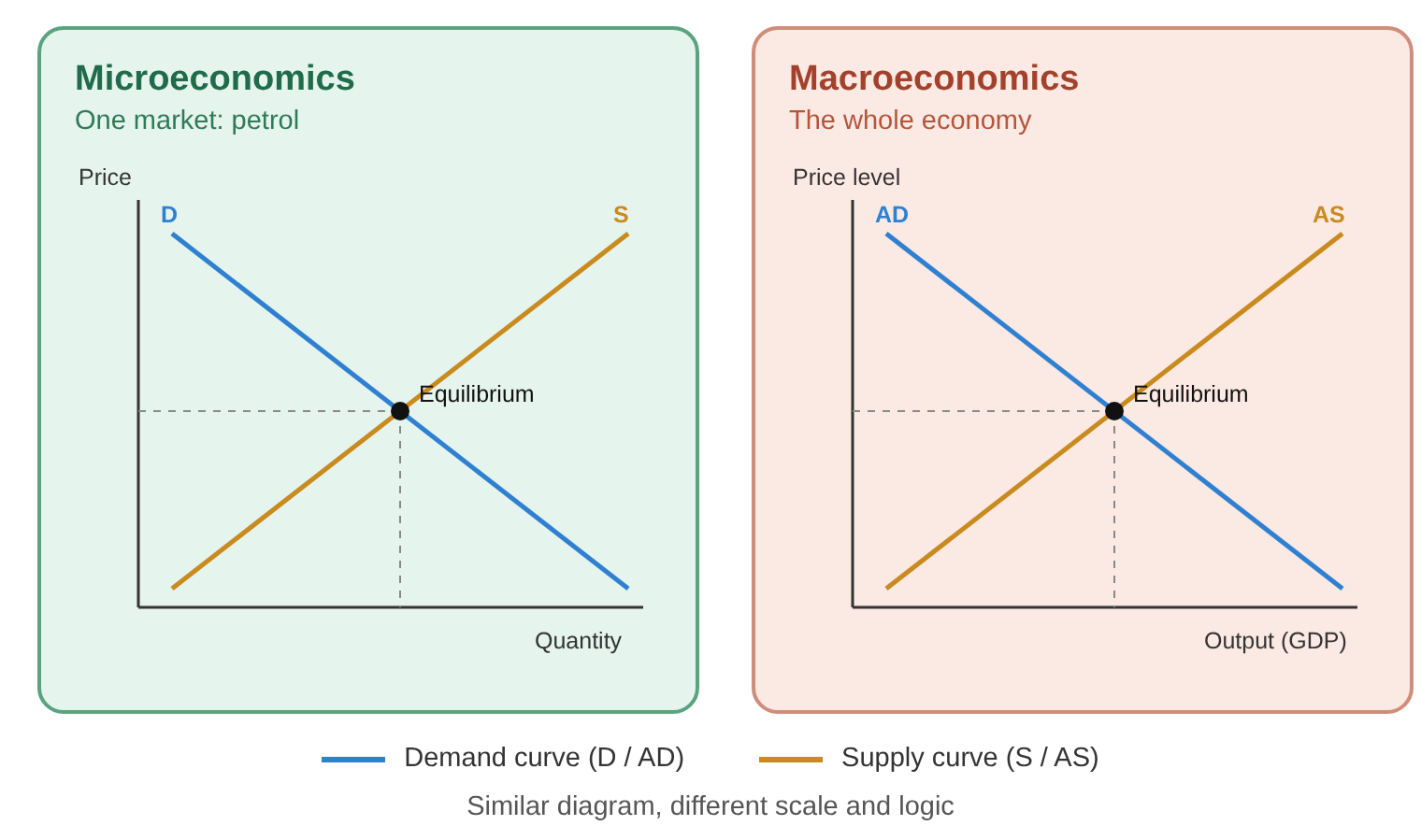
Fig. 1 — A single market (left) sets one price through supply and demand. The whole economy (right) sets the general price level through aggregate demand and aggregate supply. The diagrams look alike, but the curves slope for different reasons.
Micro vs macro economics: the key differences
Microeconomics vs macroeconomics: a real-world example
The gap between the two levels of analysis is easy to see in current data. In the UK, the Consumer Prices Index rose by 3.1% in the 12 months to August 2026, up from 2.9% in July, according to the Office for National Statistics. Unemployment held at 4.9% in the three months to July 2026, according to the ONS labour market overview. On 17 September 2026, the Bank of England held Bank Rate at 3.75%, against its 2% inflation target. In the United States, consumer price inflation was unchanged at 3.4% in the 12 months to August 2026, according to the US Bureau of Labor Statistics, while unemployment stood at 4.1% in August, per its monthly jobs report, against the Federal Reserve’s 2% inflation target. All of these are macroeconomic figures: they describe the state of an entire economy, and they move in response to economy-wide forces like central bank interest rate decisions and overall demand.
Underneath those aggregate numbers, individual markets tell their own, more specific stories. UK petrol prices rose by 9.1 pence per litre between July and August 2026, to an average of 161.3 pence, according to the ONS, a monthly increase of roughly 6% (9.1p ÷ 152.2p × 100). Diesel rose by 14.2 pence to 181.8 pence over the same period. Transport, particularly motor fuels, made the largest upward contribution to the change in that month’s UK inflation rate. This is a microeconomic story, rooted in the supply and demand of one particular good, even though it also feeds into the macroeconomic total.
This shapes the policy response. A problem confined to one market, such as weak competition or a supply bottleneck, calls for targeted microeconomic measures like competition policy or regulation. Economy-wide inflation calls for macroeconomic tools, such as a central bank raising interest rates to cool aggregate demand. Using interest rates to fix one market would hit every other market too, while market-by-market measures alone are too narrow to control the general price level, so the two often work together.
How are microeconomics and macroeconomics related?
The two are closely linked because every macroeconomic trend is built from individual decisions. Total consumer spending is the sum of millions of household decisions, and the unemployment rate reflects thousands of firms’ hiring choices and workers’ job searches. That is why many modern macroeconomic models are built on microfoundations: assumptions about how individual households and firms behave.
But the relationship isn't always simple addition. What’s sensible for one household is not automatically sensible for the economy as a whole. If a single household saves more, that's sound individual budgeting. If every household saves more at the same time, aggregate spending falls, businesses see less demand, and the economy can slow as a result – a dynamic economists call the paradox of thrift. It's a useful reminder that macroeconomic outcomes can't always be read straight off individual, microeconomic behaviour.
Where to study microeconomics and macroeconomics next
Our microeconomics section covers market-level topics, including:
Our macroeconomics section covers economy-wide topics, including:
