Photo by Ambre Estève / Unsplash
Collusion Definition: Types, Examples & Diagram
What Is Collusion?
Collusion is an agreement between firms in an oligopoly to coordinate their pricing or output rather than compete. Instead of independently setting their prices and output, colluding firms coordinate their actions, behaving more like one large monopoly, restricting output and charging a higher price. This is one of the clearest examples of how an oligopoly market structure can diverge from a competitive outcome without the need for a formal merger or acquisition between firms.
Tacit vs Explicit Collusion
Collusion between firms can be categorised by economists into two general types.
- Explicit collusion exists when firms reach an agreement to fix prices, allocate customers or territories, or agree bidding outcomes. Explicit collusion between companies is generally illegal under UK and EU competition law. A common form of explicit collusion is collusive tendering (often referred to as bid rigging), where firms secretly agree on who will win a tender and at what price, with other firms then submitting deliberately uncompetitive bids in order to create the illusion of competition.
- Tacit collusion exists without any form of communication or formal agreement; firms observe the prices and output of their competitors and may start to behave in parallel, for example, matching each other’s price increases. Although the end result looks like that of a cartel, tacit collusion is much more difficult for regulators to prove than explicit collusion. This difficulty arises because firms can independently adopt similar pricing strategies, making it difficult to distinguish tacit collusion from the interdependent behaviour characteristic of complex monopolies.
A cartel is a specific type of explicit collusion in which firms work together to set prices, output or market shares.
Why Collusion Happens
Firms collude to reduce competitive pressure and increase profits, but collusion can be unstable because each firm has an incentive to undercut the agreed price to attract more customers. If other firms respond by cutting their prices, the agreement can break down into a price war. Collusion is easier to sustain when there are few firms, similar costs, homogeneous products and transparent prices, as these conditions make coordination and monitoring easier.
The Effects of Collusion on Price and Output
The diagram shows how collusion affects market outcomes. In a competitive market, equilibrium occurs at price Pc and quantity Qc. When firms collude, they restrict output to Qm, where marginal revenue equals marginal cost, and charge the higher price Pm. The shaded triangle represents the resulting deadweight welfare loss.
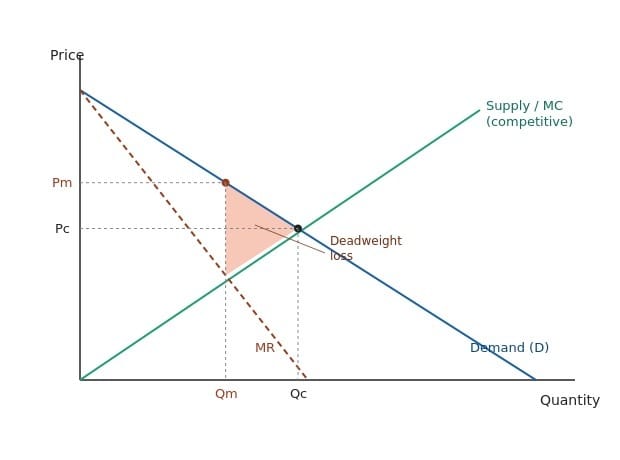
Price and output under competition vs. collusion.
Real-World Examples of Collusion
One well-known international example is the Organization of the Petroleum Exporting Countries (OPEC), whose member states coordinate oil production to influence global crude oil prices. However, OPEC is not treated as a cartel under domestic competition law in the same way as firms would be, because its members are sovereign states rather than companies subject to that law. This makes OPEC an example of coordinated production between states rather than unlawful collusion between firms.
In the United Kingdom, the Competition and Markets Authority (CMA) has taken action against BT, ITV, IMG, BBC and Sky after finding that the companies exchanged commercially sensitive information about freelance pay rates. BT, ITV, IMG and the BBC were fined a total of £4.24 million, while Sky received immunity from a fine after reporting its involvement under the CMA’s leniency programme.
In another instance, the CMA imposed fines totalling £104.46 million on Citi, HSBC, Morgan Stanley and Royal Bank of Canada after they exchanged sensitive information about UK government bonds. Deutsche Bank, which was also involved, was granted immunity after reporting its participation through the CMA’s leniency programme.
Detecting and Deterring Collusion
Competition authorities use a range of measures as part of broader regulation and competition policy to detect and deter collusion, including leniency programmes, dawn raids, analysis of market behaviour and significant fines.
- Leniency programmes: Encourage cartel members to report collusion by offering reduced penalties or immunity to firms that come forward first.
- Dawn raids: Allow competition authorities to gather evidence of collusion by inspecting business premises and records.
- Evidence and market patterns: Authorities can examine communications between firms and unusual patterns in pricing or bidding behaviour that may indicate collusion.
- Fines: Significant fines, including penalties scaled according to global turnover, can discourage firms from participating in cartels.