

Photo by Igor Omilaev / Unsplash
What Is a CDO? Collateralised Debt Obligations Explained
A collateralized debt obligation (CDO) is a financial product created by pooling debt from different sources, such as corporate loans, automobile loans and mortgage-related assets. The cash flows from these assets are used to create securities that are sold to investors. These securities are divided into different tranches, each with a different level of risk and priority in receiving payments.
During the 2000s, CDOs became heavily connected to mortgage-related assets, including securities backed by subprime mortgages. Although the structure was intended to distribute risk, it sometimes made the risks within these products difficult for investors to assess.
How Tranches Work
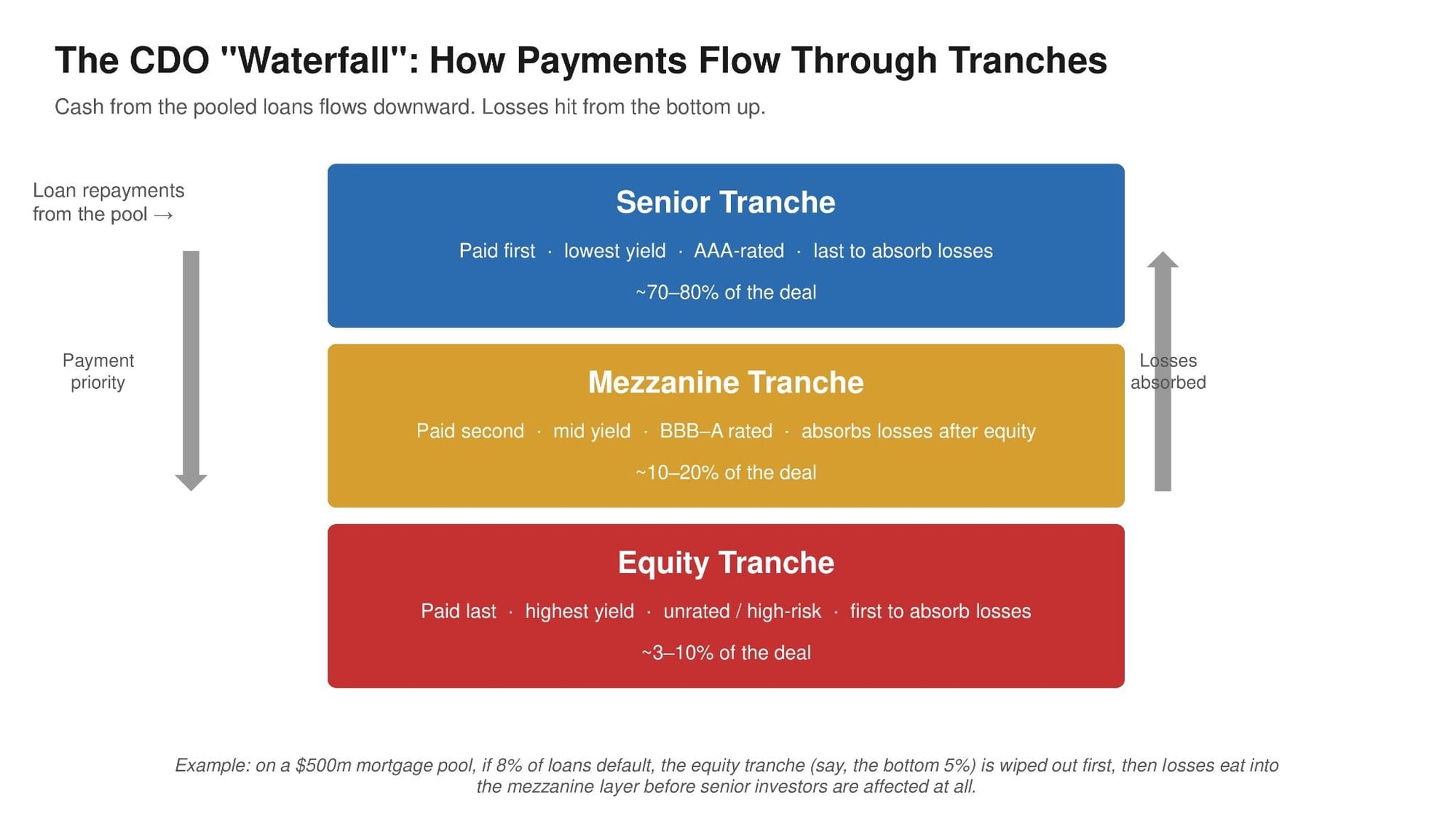
Banks and other financial institutions pool debt assets, including mortgages, and divide them into layers known as tranches. Each tranche has a different claim on the cash flows and exposure to losses.
The senior tranche is paid first and generally carries the lowest risk and return. It was often assigned an AAA rating. The mezzanine tranche is paid after the senior tranche and carries greater risk in exchange for potentially higher returns. The equity tranche is the riskiest and absorbs losses first, but offers the potential for the highest returns.
A Simple CDO Example
Consider a CDO containing a $500 million pool of assets. Suppose the equity tranche is $25 million, the mezzanine tranche is $75 million and the senior tranche is $400 million.
If 8% of the assets default, losses total $40 million. The first $25 million wipes out the equity tranche. The remaining $15 million is absorbed by the mezzanine tranche, leaving it with $60 million. The senior tranche remains untouched.
Now suppose the default rate rises to 25%. Losses would total $125 million. The entire equity and mezzanine tranches would be wiped out, accounting for $100 million of losses. The remaining $25 million would then be absorbed by the senior tranche, reducing it from $400 million to $375 million.
This shows how a security could receive an AAA rating even when it was backed by risky assets. The protection depended on losses remaining sufficiently low and uncorrelated.
The Economic Forces at Work
The economic logic behind tranching was based on pooling and diversification. If a pool contained many relatively independent loans, a small number of defaults would not necessarily create large losses for senior investors.
However, asymmetric information created a problem because loan originators could have more information about the quality of mortgages than investors buying the CDOs. This information gap meant investors could struggle to accurately assess the risks of the underlying loans. Moral hazard was another concern. It occurs when a party takes greater risks because it does not bear the full consequences of those risks. In this case, lenders that could transfer loans to other investors might have had weaker incentives to maintain strict lending standards.
CDO demand pushed lenders towards subprime borrowers, whose mortgages carried greater credit risk. As demand for mortgage-related securities increased, some lenders loosened lending standards, contributing to a deterioration in the quality of the underlying loans.
A further problem was correlated defaults, which occur when borrowers default at the same time because they are exposed to similar economic conditions. Many borrowers were affected by changes in house prices and employment. When house prices fell and economic conditions deteriorated, large numbers of borrowers could default simultaneously. Losses could therefore move through the equity and mezzanine tranches more quickly than expected, eventually reaching senior securities.
Real-World Ramifications
The CDO market expanded rapidly before the 2008 financial crisis. SIFMA reported that global funded CDO issuance reached $488.6 billion in 2006, nearly double the $249.3 billion issued in 2005.
The problems became increasingly visible in 2007. In June, two Bear Stearns hedge funds that had invested heavily in mortgage-related securities collapsed, providing an early indication of the problems ahead. In March 2008, Bear Stearns faced a severe liquidity crisis and was acquired by JPMorgan Chase with Federal Reserve assistance.
Meanwhile, AIG had sold substantial amounts of credit default swap protection linked to mortgage-related securities. As these securities lost value, AIG faced significant collateral demands and liquidity pressures and eventually required substantial government assistance.
The crisis resulted in widespread downgrades of previously highly rated securities and exposed weaknesses in the assumptions used to assess their risk. It also highlighted the need for stronger banking regulation to address risks within the financial system.
CDOs vs. Securitisation: What's the Difference?
A CDO is a type of securitisation product rather than a separate process. Securitisation is the broader process of creating securities from assets such as loans. A CDO uses this process to pool debt and divide the resulting cash flows and risks into different tranches.
In simple terms, securitisation is the process, while a CDO is one type of financial structure created through that process.
Meta description: A plain-English guide to CDOs: how they're structured, what tranches are, and why they were central to the 2008 financial crisis.
Alt text: CDO tranche waterfall diagram showing senior, mezzanine and equity tranches, with senior receiving payments first and equity receiving payments last and carrying the highest risk.

