
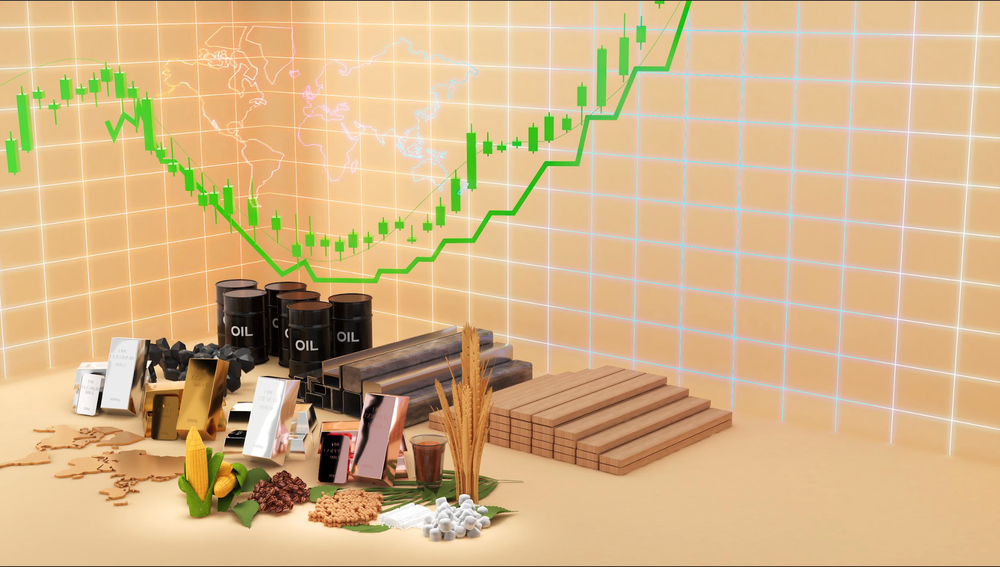
Options vs Futures: Managing Risk in Commodity Trading
Options and futures are some of the most popular derivatives offering exposure to commodities, but the two have key differences that shape trading outcomes.
Understanding how to use these for managing risk has become even more relevant these days, as commodity markets have become more volatile and unpredictable amid intensifying geopolitical conflicts. For traders, higher volatility creates opportunities, but they should also prepare to manage risk properly. Traders can open positions through options and futures on a commodity trading platform to gain market exposure while managing specific types of risk.
While futures contracts have been the standard way to trade major commodity assets, more and more traders are turning to options for specific risk management needs.
As reported by the Futures Industry Association, exchange-traded options volume climbed 39.7% year-on-year in Q1 2026 while open interest in options and TAPOs jumped 52.5%, compared with just a 2.6% rise in futures open interest - evidence that hedgers are increasingly favoring options over futures as geopolitical shocks reshape risk management.
Still, this doesn’t mean futures are being pushed aside. Both remain powerful tools to hedge commodity exposure and speculate on price movements.
Here is how they work and how they differ.
What Are Futures Contracts?
Futures contracts require traders to buy or sell the underlying commodity at a predetermined price for delivery at a stipulated time, although physical delivery is often replaced with cash settlement. They are the oldest type of derivatives, being used to lock in prices of agricultural products and quickly expanding across metals and energy assets.
Many traders use futures for hedging, as they allow short-selling and margin trading, where you can commit only a portion of the entire position.
In the US, futures trading is mostly handled by futures exchange hubs like the CME Group, which incorporates the Chicago Board Options Exchange (CBOE), the Chicago Board of Trade (CBOT), the New York Mercantile Exchange (NYMEX), and the Commodity Exchange (COMEX).
Futures contracts are more straightforward than options, as profits and losses generally move with the underlying futures price. Also, there is no upfront option premium defining the maximum loss.
Businesses use futures to lock in prices to avoid unexpected fluctuations, while institutional traders use them as a hedging tool.
Some of the advantages of futures contracts in risk management include:
- Direct price exposure: Futures track movements in the underlying commodity more directly.
- No option premium: Traders don’t have to pay an upfront premium.
- Effective price hedging: Futures provide an easy way to lock in prices.
- High liquidity: Major commodity futures have active markets.
What Are Options?
Commodity options are based on the value of underlying commodities or related futures. They give you the right to buy or sell the commodity at a predetermined strike price before or at its expiration, although you may choose not to exercise it.
A call option provides the right to buy, while a put option provides the right to sell.
The difference from futures is that an options buyer pays a premium upfront, which represents the maximum possible loss.
For example, consider a trader who is concerned that crude oil may surge due to intensifying tensions in the Strait of Hormuz, although he is not sure if a disruption will occur. Instead of buying futures contracts, he could buy a call option. If oil prices go up, the option can gain value. If the anticipated shock never happens, he can let the option expire with a loss. In this case, the loss is limited to the upfront premium, and the trader is not constrained to hold a long futures position.
Some of the advantages of options are:
- Clear risk conditions: The maximum loss is limited to the premium paid.
- No obligation to exercise: Traders are not required to exercise the option at the expiration time.
- Useful during uncertain events: Options offer exposure to potential price shocks without taking the same symmetrical downside risk as a futures position.
Options vs Futures in Commodity Risk Management
The choice between futures and options depends on what type of risk you want to take. Here is a head-to-head comparison:
Futures are associated with a more direct exposure, while options provide more flexibility. There is no better choice, as each instrument has its advantages in certain market conditions and for certain goals. The recent spike in options volumes reflects uncertainty around geopolitical events, but this doesn’t mean that interest in futures is fading.
