

Photo by Markus Winkler / Unsplash
Is the UK in a Recession? 2025-26 Economic Update
Data correct as of 7 October 2026, covering Q4 2025 to Q2 2026.
No. The UK is not currently in a recession. Real GDP has not fallen in any quarter since the end of 2025, though growth has been weak and uneven. A recession requires two consecutive quarters of falling output, and that has not happened. This page explains the current data, what's behind the weak growth, and what would need to change for that to shift.
UK Recession Definition: What the Technical Bar Actually Requires
The most widely used definition of a recession is two consecutive quarters of negative real GDP growth: output shrinking, not just slowing, for at least six months in a row. This sits within the broader business cycle, the recurring pattern of expansion and contraction that economies experience over time; a recession marks the downturn phase of that cycle.
Based on this definition, the UK is not currently in a recession. As reported by the Office for National Statistics, real GDP has not fallen in any quarter since the end of 2025: it was flat (0.0%) in Q4 2025, then grew 0.6% in Q1 2026 and 0.5% in Q2 2026. Annual GDP growth for 2025 is estimated at 1.2%. None of this describes a fall in output; instead, it describes weak growth.
Source: ONS, GDP quarterly national accounts, UK: April to June 2026 (released 30 September 2026).
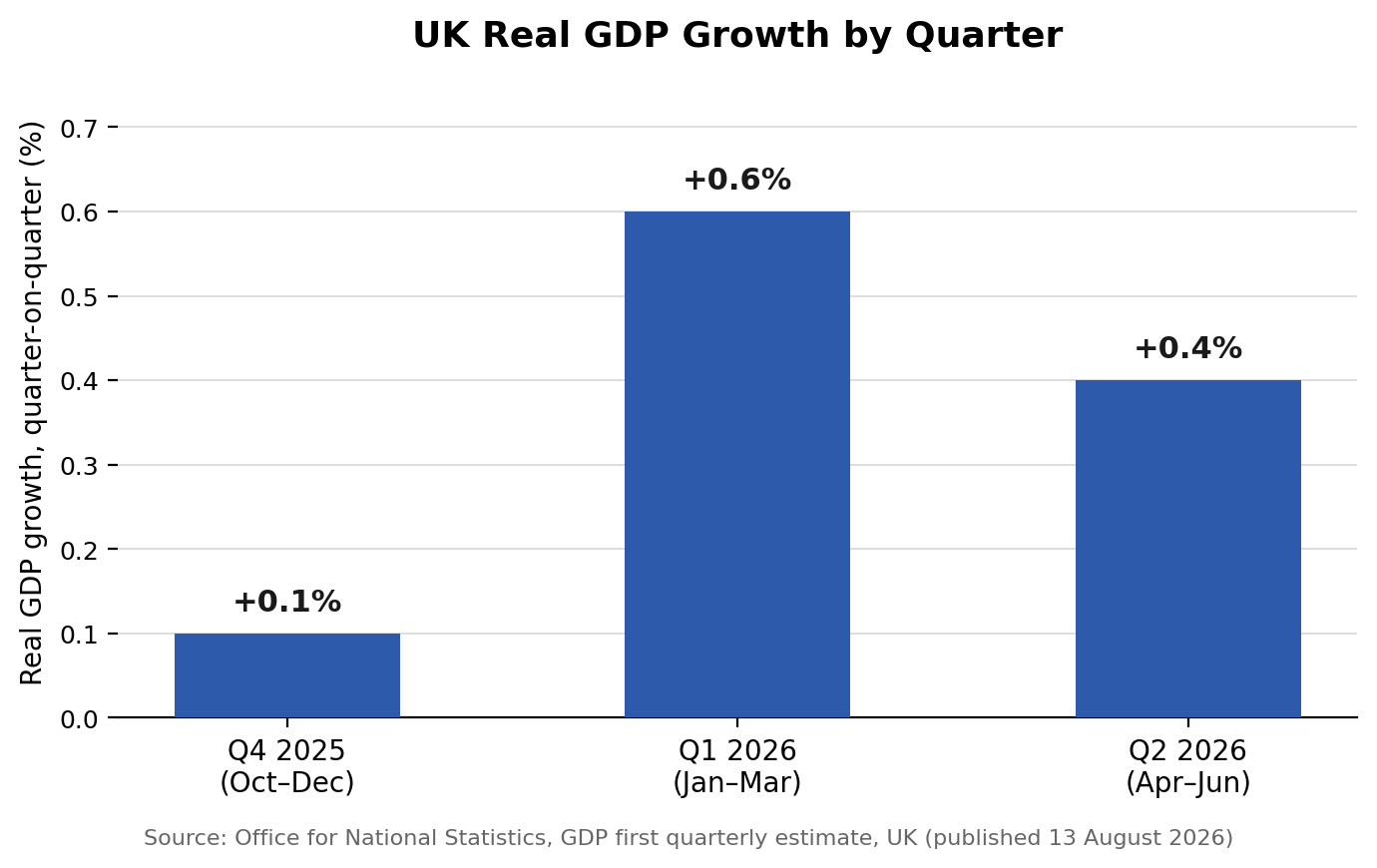
UK real GDP growth by quarter, Q4 2025–Q2 2026
UK GDP Growth: What's Driving the Slowdown
The weak growth is largely a story about aggregate demand, which combines spending by households, businesses and government with net trade. Monthly GDP figures show more volatility underneath the quarterly headline: output fell 0.1% in April 2026, was flat in May, then grew 0.3% in June and 0.4% in July. With growth this uneven, the UK has little capacity to absorb unforeseen economic shocks, such as higher oil prices.
In an extreme downside scenario first reported by Bloomberg in August 2026, internal Treasury modelling briefed to the Prime Minister suggested UK GDP growth could fall as low as 0.3% in 2027 if disruption to shipping through the Strait of Hormuz continues to the end of 2026. This is not a published Treasury forecast; officials described it as one of several scenarios they routinely model, not a central prediction.
The Office for Budget Responsibility's March 2026 forecast predicts growth of 1.1% for 2026, while the average forecast from independent analysts, compiled by the Treasury in September 2026, stands at 1.2% for both 2026 and 2027. These forecasts point to continued weak growth, though not a fall into recession.
UK Unemployment: A Lagging Signal on the Economy
Unemployment acts as a lagging indicator; it tends to respond to changes in output only after they have already happened. UK unemployment stood at 4.9% in the three months to July 2026, up 0.2 percentage points on the year, even as GDP kept growing. That combination, weak GDP growth alongside a labour market that has already softened, is a typical example of an economy late in an expansion phase rather than one already in recession. This mirrors the pattern of cyclical unemployment, where joblessness rises only once a downturn in demand has already taken hold.
Will the UK Enter a Recession in 2026?
None of this rules out a recession appearing later. Quarters of growth can be followed by two consecutive quarters of falling output with relatively little warning, and revisions to GDP data are common: in September 2026 the ONS revised growth for the final quarter of 2025 down from 0.1% to 0.0%, and growth for the second quarter of 2026 up from 0.4% to 0.5%. For now, the technical bar for a recession has not been met, though a flat end to 2025 shows how thin the margin can be.
This snapshot reflects the ONS data available as of 7 October 2026. The next quarterly GDP figures are due on 12 November 2026. For the latest GDP release, visit the ONS GDP release page.
