

Photo by Imagine Buddy / Unsplash
The Harrod-Domar Model Explained: Capital Accumulation and Economic Growth
The Harrod-Domar Model and capital accumulation are important concepts in growth theory. Developed separately by Roy Harrod (1939) and Evsey Domar (1946), the Harrod-Domar model explains economic growth through the relationship between an economy’s savings rate and its capital-output ratio. Its simple formula makes it useful for introducing students to the relationship between savings, investment and economic growth, while also providing a basis for evaluating the limitations of capital-led growth.
The Formula
The model presents the following equation:
Where:
g = economic growth rate
s = savings ratio (savings/GDP)
k = capital-output ratio, showing how much capital is required to produce a given amount of output.
Worked Example
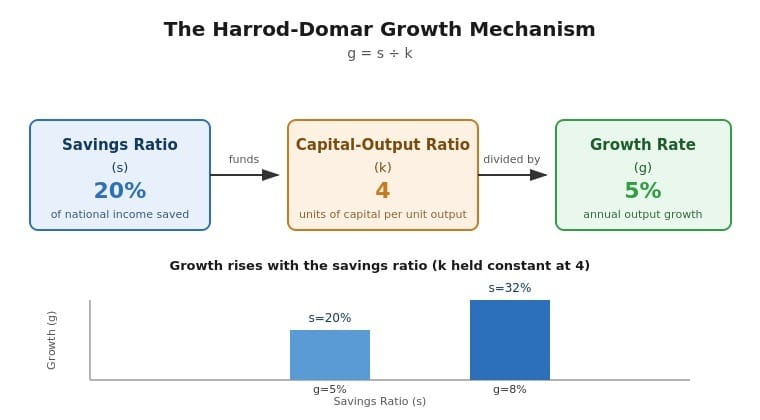
A country has a savings rate of 20% and a capital-output ratio of 4.
Because the formula uses the savings rate as a decimal, convert 20% to 0.20 by dividing by 100: 20 ÷ 100 = 0.20.
Therefore, s = 0.20 and k = 4.
g = s ÷ kg = 0.20 ÷ 4g = 0.05 = 5% growth
Consider the same country, and suppose the country desires an increase in its economy's rate of growth from 5% to 8%.
s = g × k
s = 0.08 × 4 = 0.32 = 32%
Therefore, the savings/investment rate must increase to 32% to achieve an 8% growth rate while maintaining a capital-output ratio of 4. This suggests that raising growth requires either a higher savings/investment rate or a lower, more efficient capital-output ratio (k). However, creating either one of these conditions is, however, difficult to achieve quickly.
Why This Happens: The Economic Forces at Work
The relationship rests on the Keynesian savings-investment identity: savings provide funds for investment, while investment increases the economy’s productive capital.
Because capital was treated as the binding constraint on growth, mobilising additional domestic or foreign savings was expected to increase investment and therefore growth. Savings represent a withdrawal from the circular flow of income, while investment provides an injection that can support economic activity and output. This logic underpinned the “financing gap” approach used by the World Bank and IMF from the 1950s through the 1980s, whereby foreign aid was used to help fill the gap between domestic savings and the investment needed to meet a target growth rate.
Real-World Examples
The Soviet Union pursued very high levels of investment. Capital investment was about 30% of GNP annually, a level that helped sustain economic growth despite significant inefficiencies. However, the experience also illustrates a key limitation of the Harrod-Domar model: high levels of capital investment alone cannot guarantee sustained growth when productivity and efficiency are weak.
Sub-Saharan Africa provides a more cautionary example. From the 1960s to the 1990s, many countries received substantial foreign aid, with financing-gap methodology used to estimate the external resources needed to support investment and targeted growth.
However, actual growth frequently fell short of projections based on the financing-gap approach. IMF data show that real GDP per capita in Sub-Saharan Africa, excluding South Africa and Zaïre, declined by an average of 0.7% per year between 1986 and 1993 (International Monetary Fund, 1994). This suggests that external finance did not automatically translate into the level of productive investment or growth expected by the financing-gap approach. The experience therefore illustrates a weakness in the approach: the relationship between external finance, investment and economic growth was not as straightforward as the model assumed.
Warranted, Natural and Actual Growth
The warranted growth rate is the rate at which producers are satisfied with their investment decisions, so that planned saving and investment are consistent with continued growth. The natural growth rate is the maximum sustainable growth rate determined by factors such as population and labour-force growth and technological progress, while the actual growth rate is the rate the economy actually achieves.
Limitations
Constraints on Raising Savings
- Savings can be difficult to accumulate in low-income economies because households have little disposable income, while underdeveloped financial systems may limit opportunities to channel savings into productive investment.
What the Model Omits
- The model treats the capital-output ratio (k) as fixed, overlooking the roles of human capital, technological progress, innovation and productivity improvements in generating growth. Later growth theories, such as Solow’s model, incorporate these factors more explicitly.
- The model focuses on the quantity of investment needed to generate growth but says little about the quality or sustainability of that growth. Investment-led expansion can create environmental or social costs, issues addressed by later thinking on sustainable growth.
Instability and Diminishing Returns
- The knife-edge problem suggests that if actual growth diverges from warranted growth, the economy does not automatically self-correct; instead, the divergence can become cumulative, creating instability.
- Diminishing returns to capital can also undermine the model’s emphasis on capital accumulation. Without complementary improvements in institutions, education, infrastructure and technology, additional investment may become progressively less productive.
For exams, the Harrod-Domar model is best used as a starting point for explaining the relationship between savings, investment and growth, followed by a critical discussion of why capital accumulation alone cannot fully explain real-world growth.
Sources
- Central Intelligence Agency (CIA). Soviet Economic Problems and Prospects (1978). The report states that investment comprised nearly 30% of Soviet GNP in 1975. CIA source
- International Monetary Fund (IMF). (1994). Effects of Macroeconomic Stability on Growth, Savings, and Investment in Sub-Saharan Africa. The source supports the −0.7% annual decline in real GDP per capita in Sub-Saharan Africa, excluding South Africa and Zaïre, during 1986–93. IMF source

