

Photo by Ben Wicks / Unsplash
Types of Labour in Economics
What Is Labour in Economics?
Labour refers to the physical and mental effort that human beings contribute to the production of goods and services in exchange for a reward, usually a wage or salary. A worker assembling cars, a surgeon performing an operation, and a software developer writing code are all supplying labour, despite doing very different jobs. What unites them is that each is applying human effort, whether physical, mental, or both, to a productive process. Labour is one of the four factors of production, alongside land, capital and enterprise, each contributing a different kind of input to the production process.
The main types of labour in economics are classified by skill level (unskilled, semi-skilled, skilled and professional), by type of effort (physical and mental), by output (productive and unproductive), by formality (formal and informal) and by mobility (occupational and geographical).
Types of Labour by Skill Level
The most common classification splits labour according to skill and training requirements.
- Unskilled labour requires little or no formal training. Examples include cleaning, basic manual assembly work, or portering. Because the supply of workers able to do these jobs is relatively large, wages for unskilled labour tend to be lower.
- Semi-skilled labour requires some training or experience but not extensive formal qualifications. A machine operator or a delivery driver typically falls into this category.
- Skilled labour requires specific training, apprenticeships, or vocational qualifications. Electricians, plumbers, and carpenters are classic examples. Skilled labour commands higher wages than unskilled labour because fewer workers possess the necessary training, restricting the supply of skilled workers relative to demand.
- Professional labour requires advanced education, often a degree or postgraduate qualification, along with specialised training. Doctors, architects, and engineers fall into this group. This category typically commands the highest wages, reflecting the scarcity of qualified workers and the high productivity associated with specialised expertise.
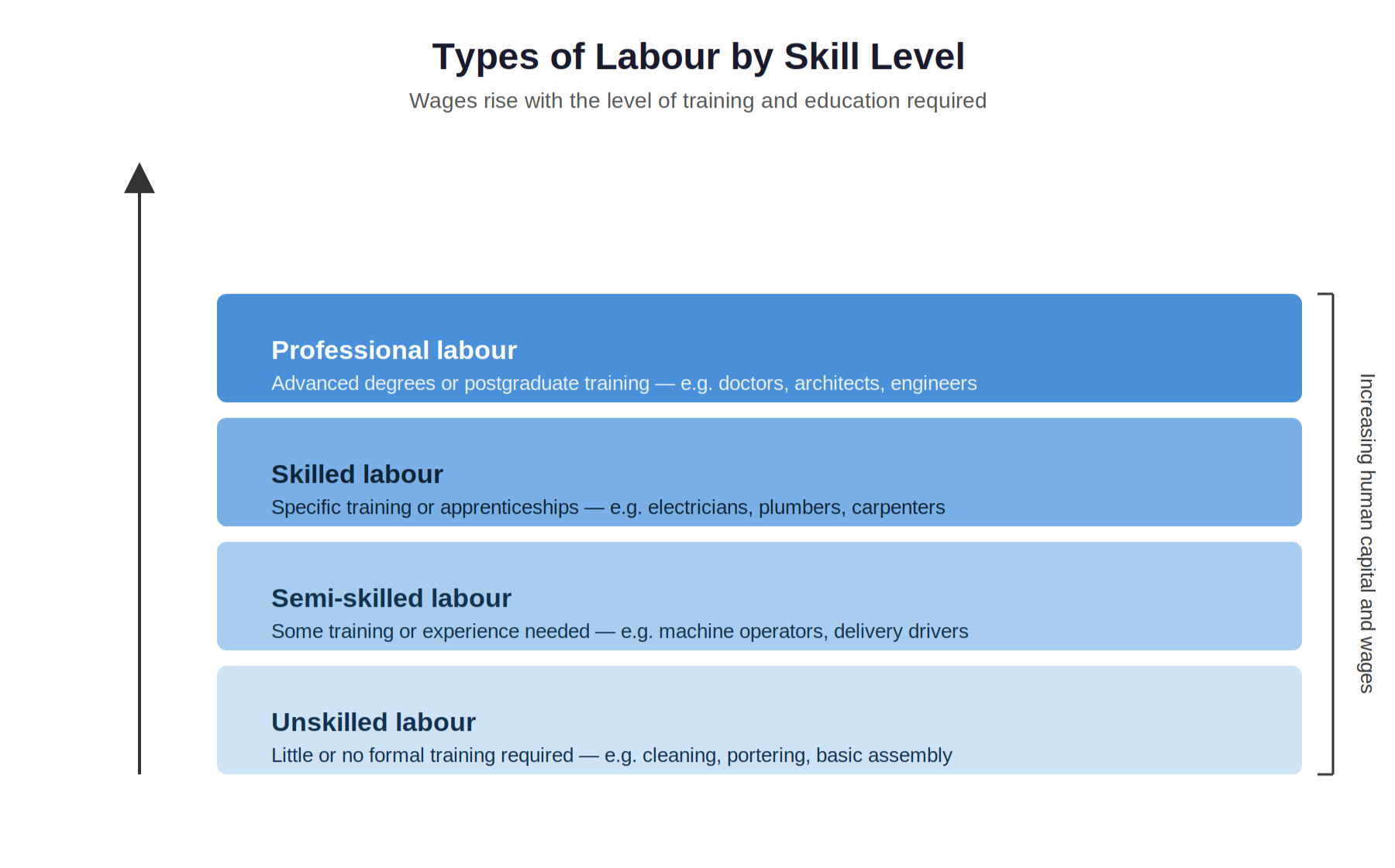
This skill-based hierarchy connects directly to human capital theory, developed by economists such as Gary Becker. The theory treats education and training as an investment that raises a worker's future productivity and earning potential, in much the same way a firm invests in machinery. The greater a worker's human capital, the more valuable their labour tends to be in the market.
Physical Labour vs Mental Labour
A second distinction separates labour by the type of effort involved.
Physical (manual) labour involves bodily exertion; farming, construction, and warehouse work are examples. Mental (intellectual) labour involves cognitive effort, such as research, teaching, accounting, or design work. In practice, most jobs combine both to some degree, but the distinction remains useful for thinking about how automation affects different occupations. Routine physical tasks have historically been easier to automate than tasks requiring judgement, creativity, or interpersonal skill. Economists call this routine-biased technical change. It overlaps with skill-biased technical change, the idea that new technology raises demand for highly skilled workers compared with less skilled ones.
Productive Labour vs Unproductive Labour
Classical economists, most notably Adam Smith in The Wealth of Nations (1776), divided labour into two categories. Productive labour created tangible goods that could be sold, adding to a nation’s stock of wealth, such as furniture or crops.
Unproductive labour, in the classical view, provided services that were consumed as they were delivered, without creating a lasting, tradable product. A musician performing live is an example. Modern economists have largely dropped the distinction. Services made up around four-fifths of UK output in 2024, and any labour that produces something people are willing to pay for, whether a good or a service, counts as productive.
Formal (Organised) vs Informal (Unorganised) Labour
Labour markets can also be classified according to how formally they are structured. Formal (organised) labour operates within regulated employment structures, often unionised, with written contracts, statutory protections such as the minimum wage, and employment rights. Informal (unorganised) labour operates outside these structures, in casual, seasonal or gig-economy work, often without job security or benefits. This distinction matters enormously in developing economies, where a large share of the workforce may work informally, but it is increasingly relevant in developed economies too, given the growth of platform-based gig work such as ride-hailing and food delivery, where workers are often classified as self-employed contractors rather than employees. That classification matters: in the UK, anyone legally classed as a worker, including casual and zero-hours staff, is entitled to the minimum wage, but genuinely self-employed contractors are not.
Occupational and Geographical Mobility of Labour
Economists distinguish between occupational mobility, which is the ability to move between roles or occupations, and geographical mobility, which is the ability to relocate between geographical areas for work.
Occupationally mobile workers have skills that transfer from one occupation to another. Conversely, workers with limited occupational mobility have skills specific to a particular type of work or occupation, making it more difficult for them to move into other fields. For example, former coal miners in South Wales and northern England struggled to move into service-sector jobs after pit closures in the 1980s.
Geographically mobile workers are able to relocate to seek employment, while geographically immobile workers have situations that prevent them from relocating, such as family obligations, housing costs, and cultural attachment to the area. Limited labour mobility is linked to higher regional unemployment, since workers from distressed industries are often unable to relocate to areas with available jobs.
Why Do Types of Labour Matter in Economics?
These classifications serve a purpose beyond simply categorising labour, as they help explain wage disparities, including differences in the scarcity and supply of workers with different skill levels. Workers with scarce, specialised skills may command higher wages than workers whose skills are more widely available. They also illustrate why certain sectors are more susceptible to automation than others, why labour markets function differently in developing and developed countries, and why the effectiveness of government policies on education, training and job security may vary across different types of labour. A government seeking to reduce structural unemployment, for instance, might invest in retraining programmes aimed specifically at occupationally immobile workers whose skills have become obsolete.
Understanding the different types of labour therefore provides a foundation for analysing many of the central questions in labour economics, including wage determination, income inequality, and the changing nature of work in an increasingly automated global economy.
