

Photo by Tierra Mallorca / Unsplash
Liquid Assets: Definition, Examples and Why Liquidity Matters
Data currency note: UK Bank Rate and gilt yield figures are correct as of September 2026.
A liquid asset is anything you can turn into cash quickly, cheaply and at close to its full market value. Cash itself is the benchmark, sitting at the most liquid end of the liquidity spectrum. How cheaply an asset can be sold is usually measured by the bid-ask spread, the gap between what buyers will pay and what sellers ask. Next in line come easy-access savings accounts, money market funds, short-dated UK government bonds and other liquid deposits, which typically give access to cash within one business day with little change in value. Listed shares are also liquid, but their prices can move significantly between the time of purchase and the time of sale.
The term is used in three slightly different senses. In personal finance, liquid assets are the part of your wealth you can draw on quickly, such as an emergency fund. In business accounting, they are the current assets a firm can turn into cash to pay its short-term bills, often measured by the quick ratio. In banking, regulators use the term 'high-quality liquid assets' for the cash and government bonds banks must hold to survive a run.
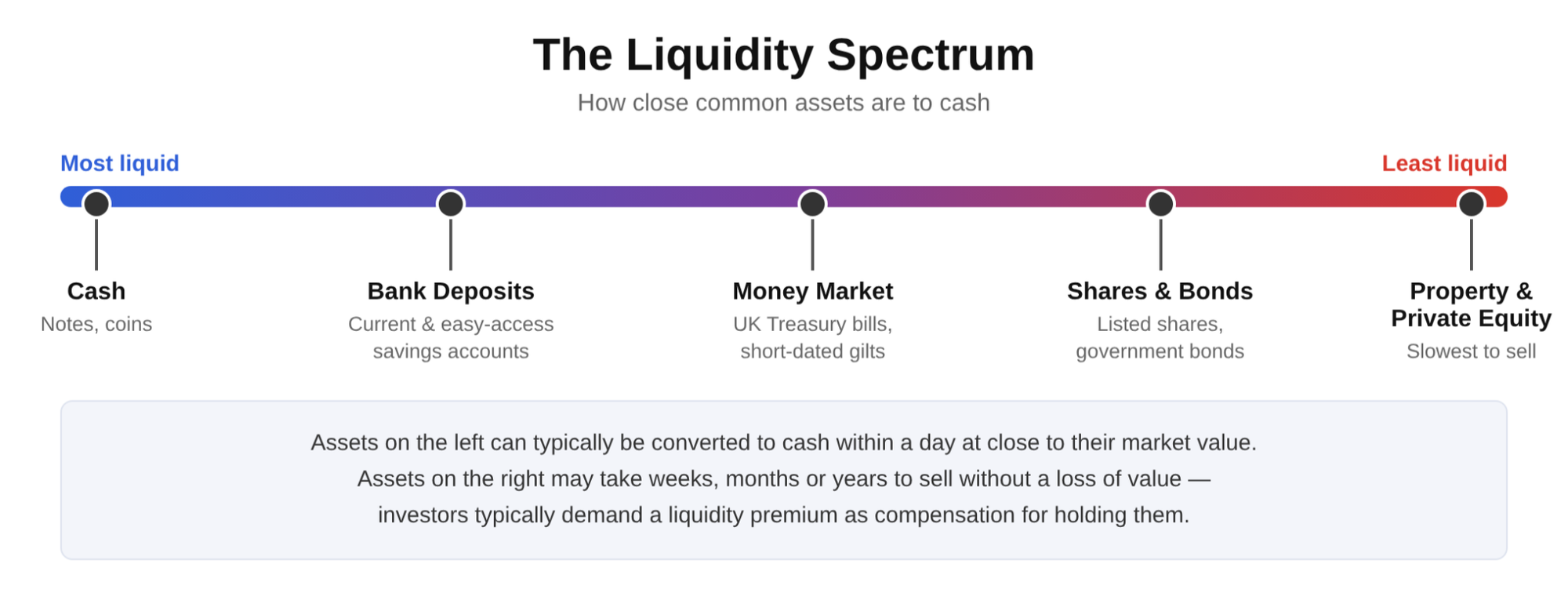
Examples of Liquid Assets
Liquid assets typically include:
- Cash and cash equivalents: physical currency and funds in current or easy-access savings accounts.
- Money market instruments: short-dated government and corporate debt, such as UK Treasury bills, that trade in the money markets and can usually be sold within a day or two.
- Listed shares and government bonds: shares on major exchanges can normally be sold within minutes during trading hours, while government bonds, traded mainly between dealers rather than on an exchange, can usually be sold within a day.
- Accounts receivable: for businesses, invoices due for payment shortly count toward a firm’s liquid position.
Businesses often measure their liquid position with the quick ratio, which compares their most liquid assets with the bills due in the next year. A firm with £50,000 in cash, £30,000 in receivables, £40,000 in stock and £60,000 of current liabilities has a quick ratio of (50 + 30) ÷ 60 = 1.33. Stock is left out because it can take time to sell. For more on how liquidity works across markets, see our liquidity section.
Liquid vs Illiquid Assets
At the other end of the liquidity spectrum, illiquid assets include property, private equity, fine art and small businesses, along with collectables and long-term fixed deposits. These assets may rise in value or hold it, but they typically take weeks, months or even years to sell, and selling them usually costs something. A seller under pressure to sell quickly may have to accept a discount to market value, often a substantial one, to find a buyer.
The Liquidity Premium: Why Illiquid Assets Pay More
The liquidity premium is the additional return investors require for holding an investment that cannot easily be converted into cash. Holding cash has an opportunity cost: the same pound could earn more in shares (through the equity risk premium) or in property and private credit (partly through the illiquidity premium).
This is closely tied to John Maynard Keynes’s liquidity preference theory, which explains that households and firms hold cash for transactional, precautionary and speculative motives, and that interest rates are essentially the price paid to persuade people to give up that liquidity. Longer-dated bonds show a related but different effect. On 17 September 2026, the Bank of England’s Monetary Policy Committee voted 6–3 to hold Bank Rate at 3.75%, broadly the return available on near-cash instruments. A week earlier, the 10-year gilt yield had climbed to around 5.38%, its highest level since 2007, according to Reuters. That roughly 1.6 percentage point gap is mostly a term premium, the extra return for tying money up for longer and taking on interest-rate risk. The Bank’s minutes from the same meeting estimate that term premia on long-term UK government bonds have risen by around 200 basis points since February 2022, and term premia are one reason yield curves usually slope upward under normal conditions. A clearer example of a liquidity premium is a company’s bonds that trade only rarely, which often yield more than its actively traded bonds. Property and private equity investors expect a similar, often larger, illiquidity premium, precisely because they cannot exit their positions on short notice.
Economists have long studied the precautionary savings motive, which is the tendency of people to hold liquid assets (such as cash) in order to prepare for unforeseen events (such as job loss or medical bills). Many financial advisers recommend that their clients keep at least three to six months' worth of expenses saved in case of an emergency, even though the returns on this money are far lower than what could be achieved by investing in the stock market.
Why Liquidity Matters for the Wider Economy
Liquidity also shapes monetary policy. When central banks want to inject liquidity into a sluggish economy, they can turn to quantitative easing, buying government bonds to push down long-term interest rates and make more cash available to the banking system. The underlying goal is to ensure that cash, or something close to it, is available where it is needed in the economy. The Bank of England’s purchases, held in its Asset Purchase Facility, totalled £895 billion before it began shrinking them in February 2022. By September 2026, its remaining gilt holdings had fallen to about £488 billion, as the Bank gradually reversed its crisis-era bond purchases.
Examples of Liquidity Risk: Bank Runs and Illiquid Wealth
In March 2023, Silicon Valley Bank (SVB) demonstrated how liquidity affects individual banks. To generate returns, the bank had invested most of its deposits in government bonds and mortgage securities. Those bond values had already fallen as US interest rates rose through 2022. On 8 March 2023, SVB revealed it had sold around $21 billion of securities at a $1.8 billion after-tax loss and needed fresh capital. Depositors took that as a warning sign.
Panic spread quickly, partly fuelled by social media. On 9 March 2023, depositors attempted to withdraw $42 billion from the bank in a single day, according to a California regulatory filing, a scale that US House Financial Services Chair Patrick McHenry called “the first Twitter-fuelled bank run”. By the close of business that day, SVB’s cash balance had gone negative by roughly $958 million. The following day, 10 March 2023, the California Department of Financial Protection and Innovation closed the bank and appointed the FDIC as receiver. SVB’s problem showed up first as liquidity, not insolvency. Its bonds would have been repaid in full if held to maturity, but at market prices the losses had already eaten most of its capital. The bank faced a liquidity mismatch: long-term assets that could only be sold at a loss and short-term deposits that could be withdrawn instantly.
A smaller-scale but equally telling example is a homeowner who is "asset rich but cash poor": someone whose wealth is tied up in property may be unable to cover an unexpected bill even though their net worth looks healthy on paper, simply because the property cannot be sold or remortgaged quickly enough.
Liquidity Rules: Coverage Ratios, Deposit Insurance and Lenders of Last Resort
The SVB case shows why liquidity risk is treated as distinct from credit risk and why bank regulators impose liquidity coverage ratios, which require banks to hold enough high-quality liquid assets to cover 30 days of stressed outflows. SVB itself was not subject to the liquidity coverage ratio when it failed: rules relaxed in 2018–19 had raised the thresholds for banks of its size, and the Federal Reserve’s own review found it would not have met the full requirement.
For individual investors, the same logic applies on a smaller scale: portfolios built entirely around high-return, illiquid assets can leave someone unable to cover an emergency without selling at a loss. For policymakers, episodes like this reinforce the case for deposit insurance and for central banks acting as the lender of last resort, stepping in with emergency liquidity when private markets freeze rather than letting a liquidity crisis cascade into a broader solvency crisis across the financial system.
